
What Micropur Actually Does — And the Two Things It Can't
A hut in Saxon Switzerland, water that tasted of chlorine, and a question we hadn't really asked: what does Micropur actually protect against? It preserves clean water — it doesn't make contaminated water safe.
Preservation vs. Treatment of Drinking Water
In Saxon Switzerland, we once hiked up to a mountain hut to refill our bottles. The water came straight from the tap, looked perfectly clean — and was undrinkable. It tasted so strongly of chlorine that we left it standing.
In hindsight, that chlorine taste wasn't an annoyance but an honest warning. It meant the water utility had a reason to disinfect heavily — elevated contamination, something entering the source, whatever it was that made the chlorination necessary. And that is exactly where most people go wrong, us included at the time: we equate "tastes treated" with "is safe." The two have little to do with each other.
Chlorine deals with bacteria and viruses reliably. Against the robust pathogens that are the real problem in our waters — Cryptosporidium, Giardia, the chlorine-resistant protozoa — it does little. And where do those come from? From exactly the surface water that overlanders scoop from streams and springs along the way. Wastewater treatment plants don't fully retain these pathogens, and during heavy rain, untreated sewage runs straight back into the watercourse through the overflow. The same contaminated surface water is used elsewhere to irrigate fields — the current Cyclospora outbreak in the USA, which has made thousands ill, spreads along exactly this path.
Anyone who wants to make water drinkable on the road first has to separate two things that are constantly confused: preservation and treatment. They solve different problems, and a product made for one is of little help with the other.
Preservation
Preservation makes drinking water last longer. It allows you to store larger quantities in clean containers — whether in a PE jerrycan or a stainless steel tank. The crucial point is already in the name: preservation requires clean water to begin with. It maintains what is already drinkable by preventing microbes from multiplying during storage. It does not make contaminated water drinkable — it only preserves the state of water that is already there.
Storage itself comes with its own requirements — container material, protection from light, temperature, hygiene when filling — which make the difference between six months of shelf life and a spoiled tank. That is a topic in its own right, and one we'll devote a separate article to.
Treatment
Treatment is the opposite starting point: here the water is not drinkable, and the goal is to make it so. There are various approaches for this — chemical treatment, mechanical filtration, ozone and UV — each with its own strengths and blind spots. Which approach does what, and where it reaches its limits, is something we've already covered in detail: [Water Filtration for Overlanding – Why RO is Overkill].
The mistake this article is about arises precisely at the seam between these two terms. Micropur is a preservative — and many people treat it as a treatment solution. To understand why that goes wrong, it's worth taking a close look at what actually happens inside a Micropur tablet.
What Micropur Actually Does
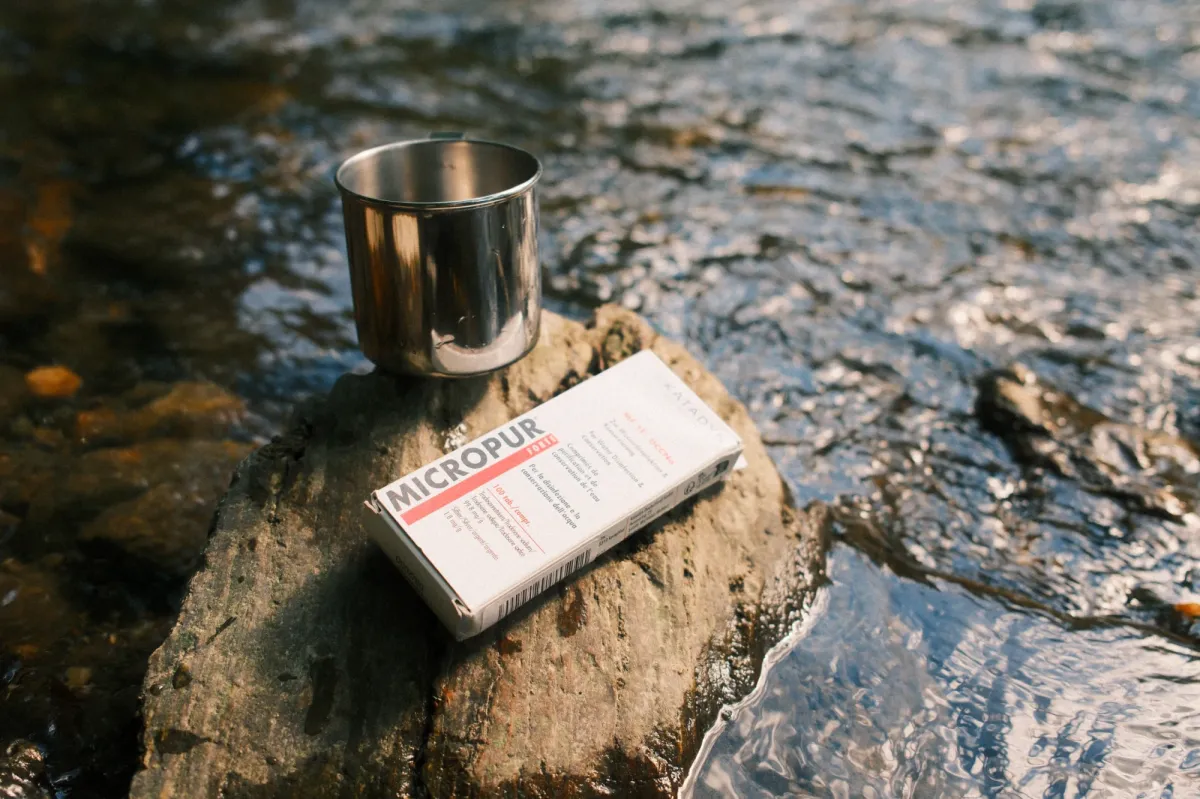
Micropur Classic works through silver ions. Silver is bacteriostatic — it inhibits the growth of microorganisms by binding to their cell walls. Katadyn's own product sheet is precise here: it preserves clear drinking water for up to six months. It contains no chlorine whatsoever. It is a preservative. It prevents whatever is already present in a tank of clean water from multiplying further.
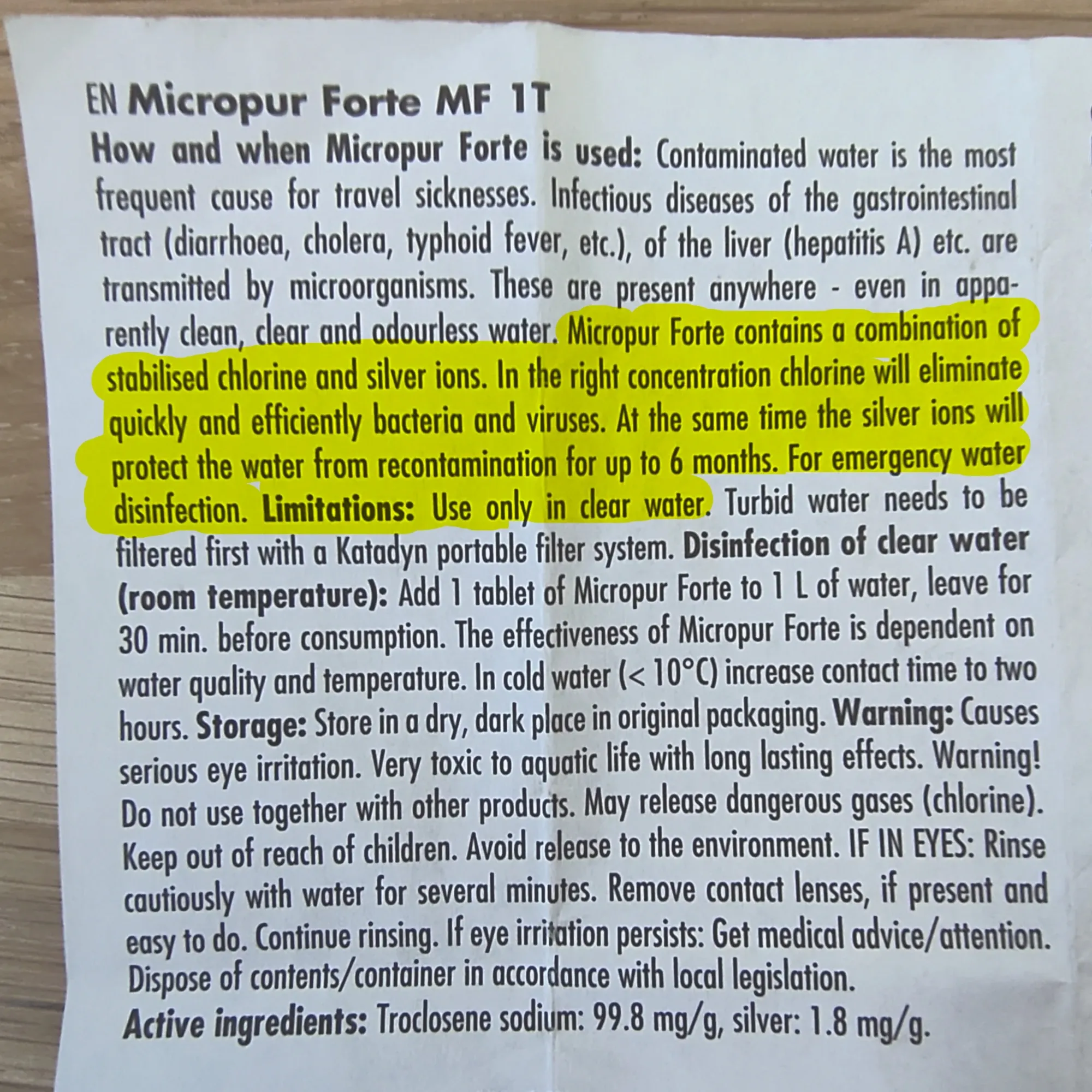
Micropur Forte adds stabilised chlorine to the silver ions. This product disinfects. On the package insert of Micropur Forte MF 1T, the manufacturer states it plainly:
Micropur Forte contains a combination of stabilised chlorine and silver ions. In the right concentration chlorine will eliminate quickly and efficiently bacteria and viruses. At the same time the silver ions will protect the water from recontamination for up to 6 months. For emergency water disinfection. Limitations: Use only in clear water.
The manufacturer states openly where the limits lie: clear water only, effective against bacteria and viruses, and explicitly intended for emergencies. This is not a criticism of Micropur — Katadyn describes its product correctly. The error only arises with us, when we read more into it than is written.
Because there is one question the insert deliberately leaves unanswered: what about protozoa and helminth eggs?
The Gap the Insert Leaves Open
Chlorine kills by oxidation. It attacks the cell membrane, denatures proteins, brings metabolism to a halt. Against bacteria and viruses, this is fast and reliable. Against pathogens that have evolved a protective shell, it runs into a wall.
Cryptosporidium is the clearest case. Its oocysts — 4 to 6 micrometres across — carry a wall so robust that they survive the highest chlorine concentrations used anywhere in conventional drinking water treatment. For a 3-log inactivation, the US health authority CDC specifies a Ct value of roughly 15,300 mg·min/L. Ct is concentration multiplied by contact time, so that number means: 20 mg/L of free chlorine, held for nearly thirteen hours. Health Canada draws the obvious conclusion: at any concentration where you'd still want to drink the water, chlorine is not a reliable barrier against Cryptosporidium. This is why chlorinated swimming pools, of all places, produce cryptosporidiosis outbreaks with grim regularity.
Giardia is more reachable, but slow. Cysts require long contact times — time nobody waits out when they're thirsty and want to drink in twenty minutes.
Helminth eggs — Ascaris, Trichuris, and their relatives — sit at the far end of the resistance scale. Their multi-layered shell, with a lipoprotein inner membrane, is practically impervious to the disinfectants used in field water treatment. They are also large — 20 to 80 micrometres — and that is precisely the point: they are effortless to filter and nearly impossible to poison.
Turbidity undermines the whole principle. Suspended solids consume free chlorine before it reaches a pathogen — chlorine demand, in the technical literature. Dose for a clear glass and drop the tablet into cloudy water, and you have neither the concentration you calculated nor any way to notice. That is exactly what the "clear water only" line on the package protects against — and exactly the line almost everyone skips.
Other contaminants — PFAS, heavy metals, pesticides — lie entirely outside the mechanism. They simply stay in the water.
Why This Matters Right Now
Some of these pathogens aren't just theoretically relevant. Alongside Cryptosporidium and Giardia, the chlorine-resistant protozoa include Cyclospora — and it is currently making thousands of people ill in the USA. The pathogens originate in human faeces and reach fresh produce, eaten raw, via contaminated irrigation water. The route of transmission therefore runs through surface water that has been in contact with sewage — exactly the kind of water overlanders scoop from streams and springs along the way. What contaminates the lettuce in the field ends up straight in the overlander's bottle.
And this surface water is never safe by default. Wastewater treatment plants don't fully retain protozoa like Cryptosporidium and Giardia even in normal operation — a portion passes through the plant and leaves with the effluent into the watercourse. During heavy rain it gets more drastic: untreated sewage then runs straight into the watercourse through the combined sewer overflow, bypassing the plant entirely. The stream that looks clean may have taken in exactly that upstream.
A Multi-Stage Filtration System
This is exactly where the Pump Case comes in. Against the robust pathogens — Cryptosporidium, Giardia, worm eggs — no chemistry helps, only a physical barrier. That barrier is a membrane with a cut-off of 0.1 µm. The manufacturer markets it as a "nano" filter; technically, that is ultrafiltration, since true nanofiltration separates two to three orders of magnitude finer. What matters in practice isn't the name anyway, but the pore size — and 0.1 µm reliably retains protozoa, bacteria, and worm eggs.
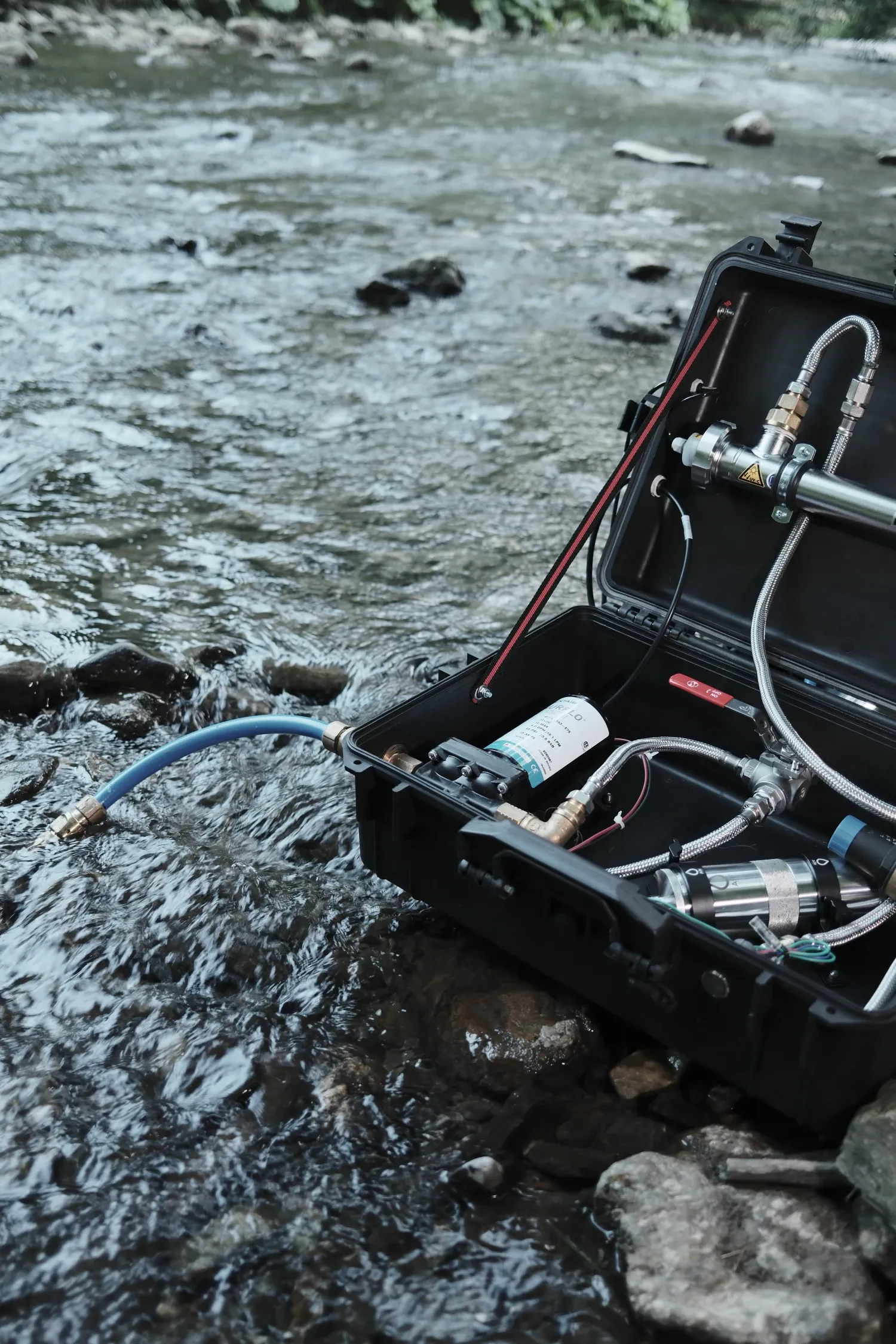
This stage has one known gap: viruses, at 0.02 to 0.3 µm, are small enough to partly pass a 0.1 µm membrane. And that gap is exactly what the UV stage closes. UV inactivates viruses reliably — but has a weakness of its own, namely turbidity: suspended solids cast shadows behind which pathogens survive.
Read more about different filtration classes here:
 Sebastian Weiß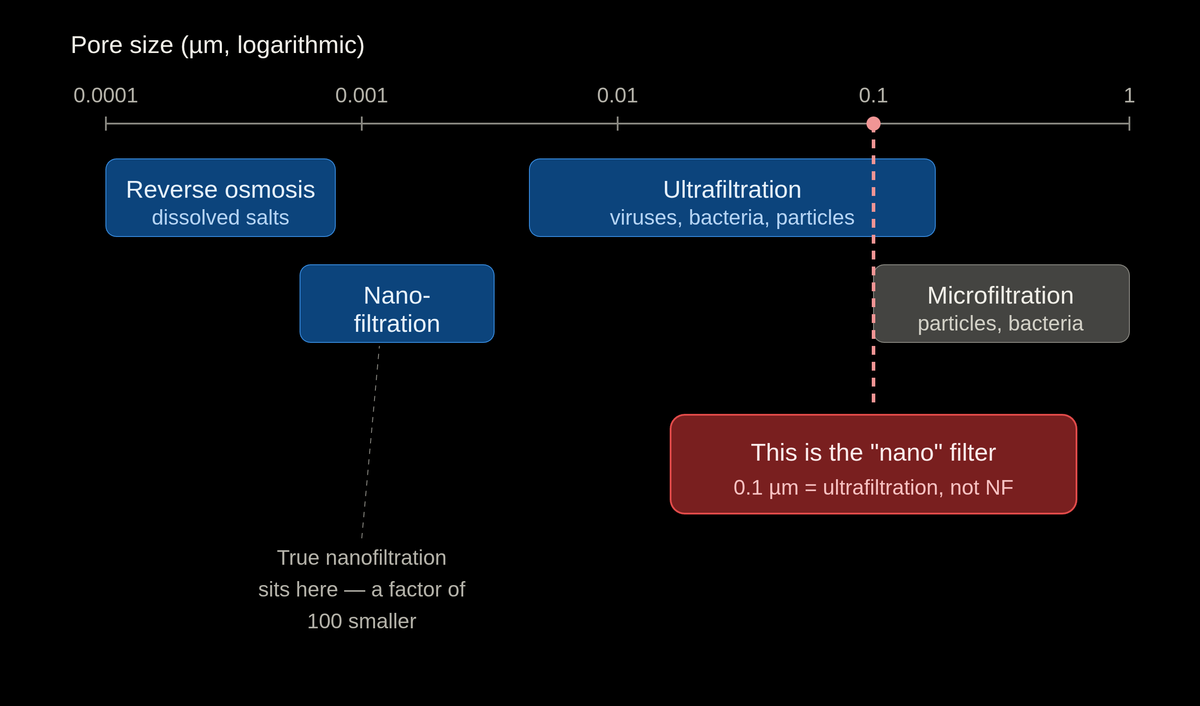
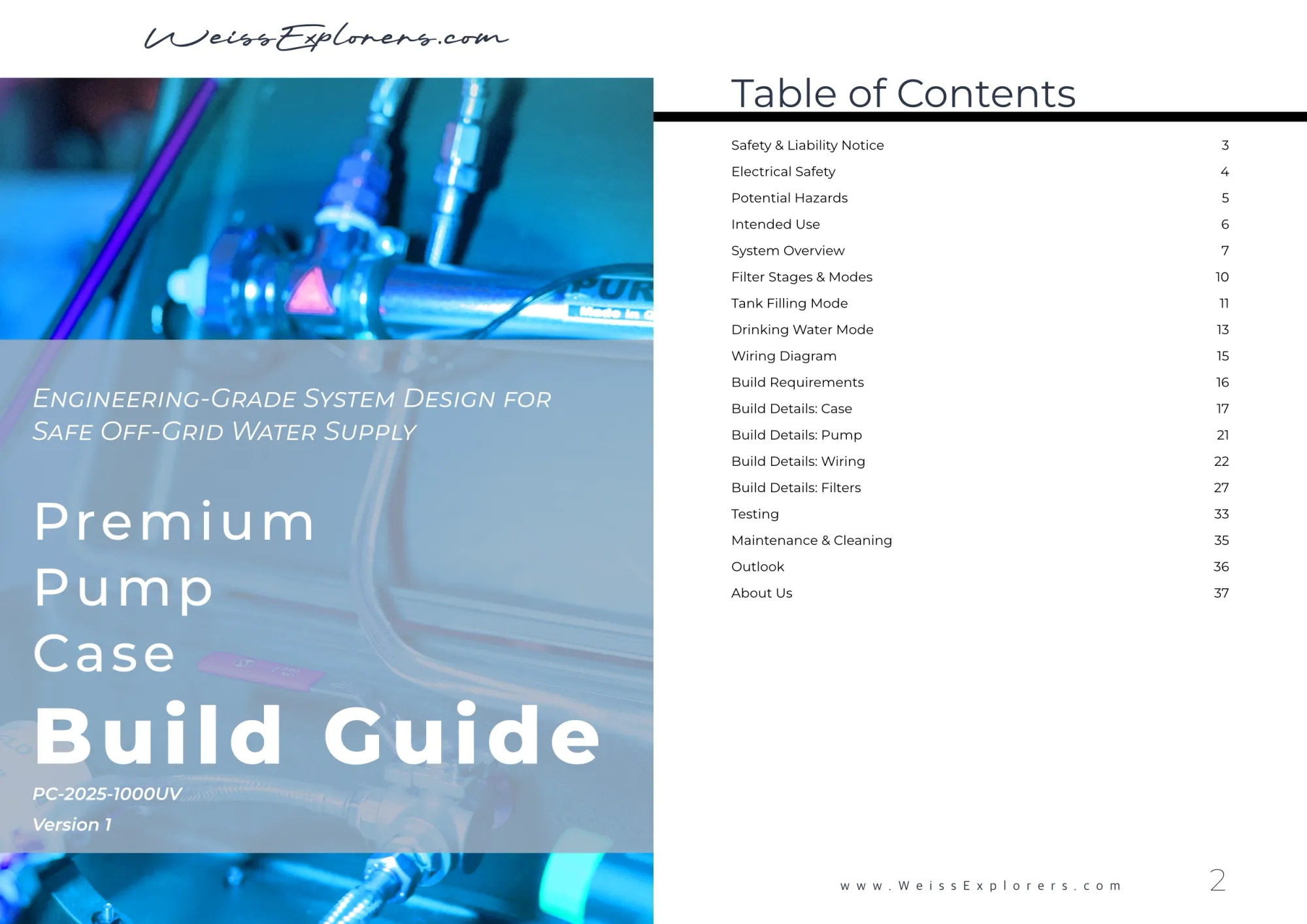
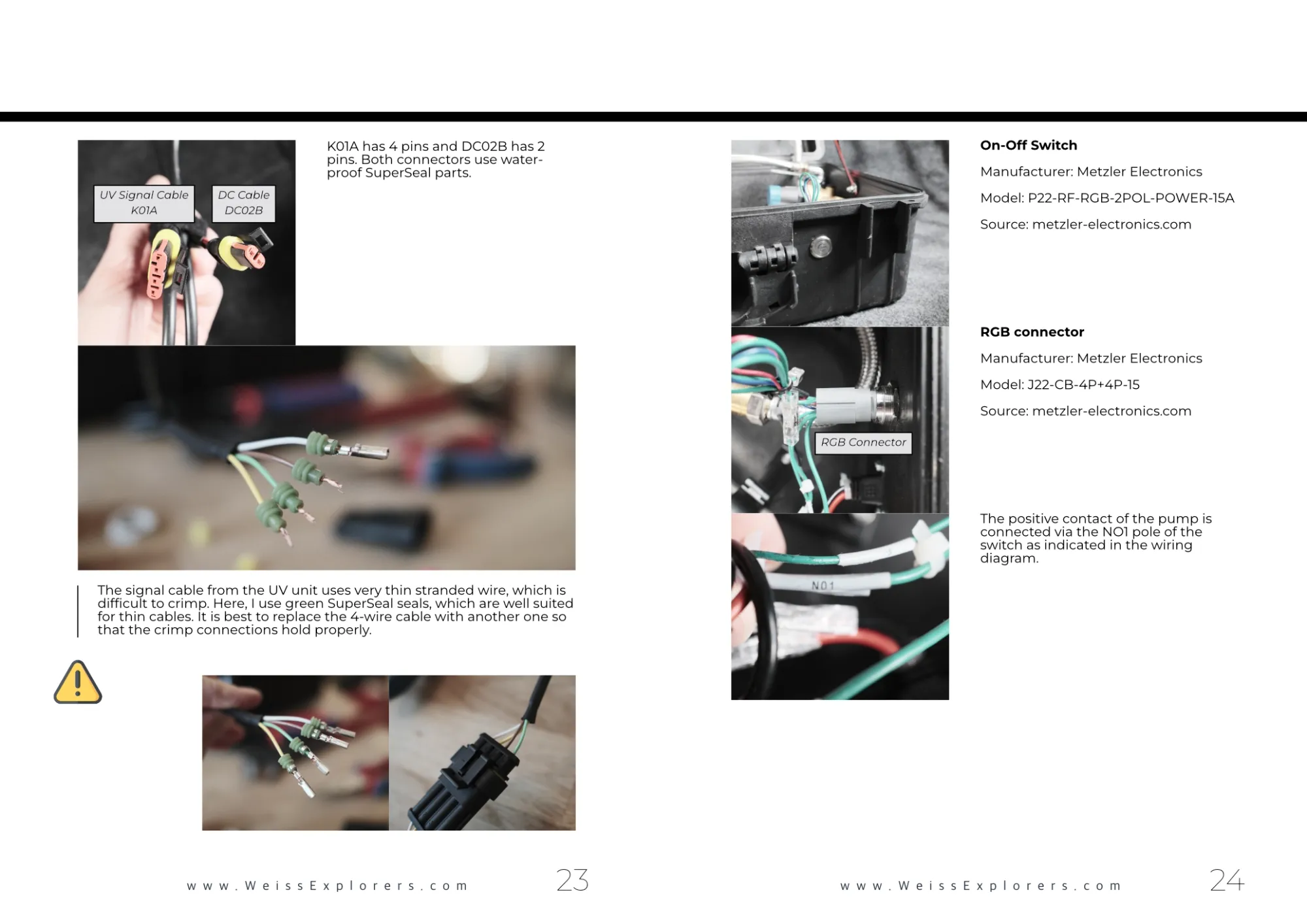
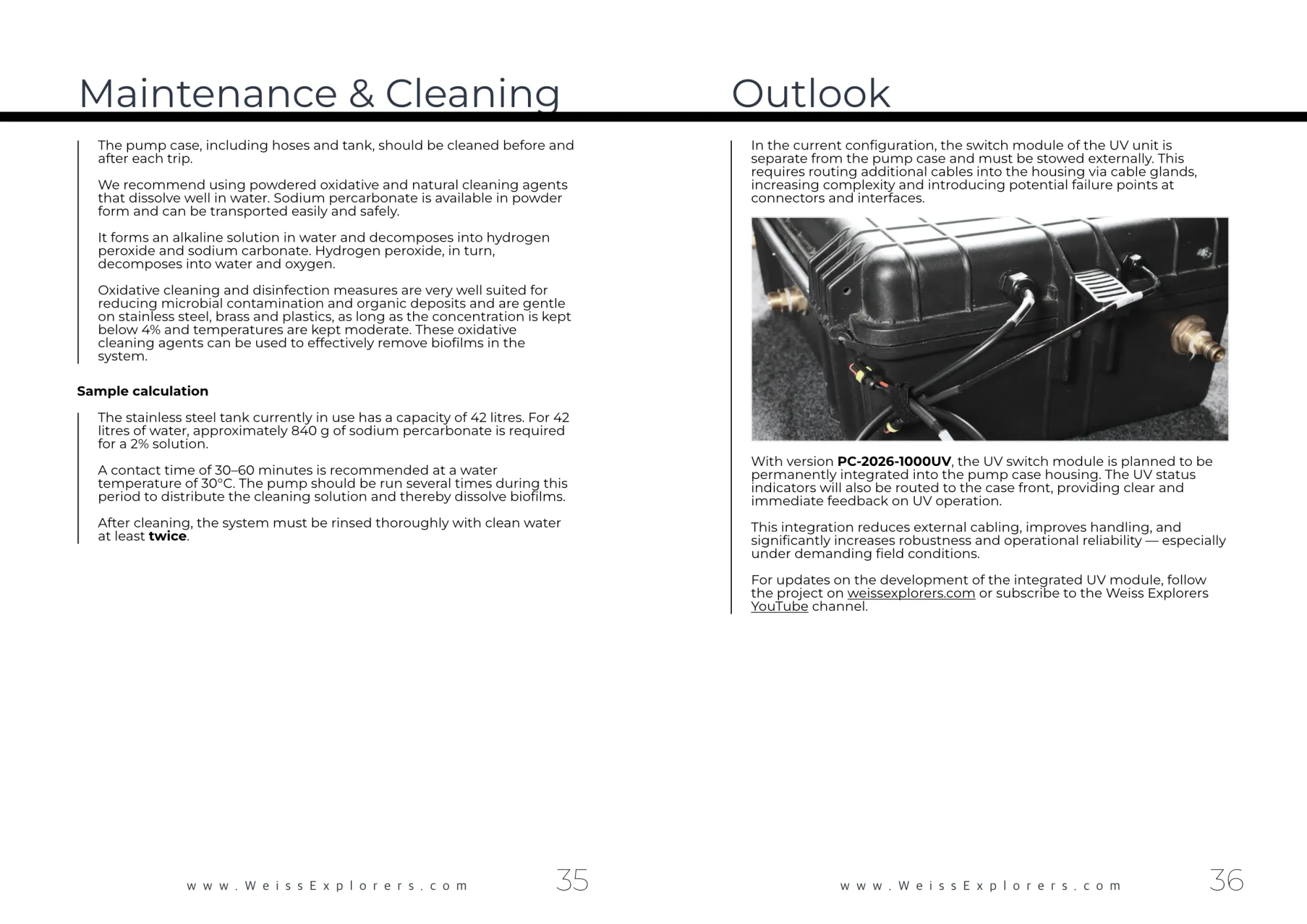
About the Pump Case Build Guide
What's inside
- 37 pages of technical documentation
- Step-by-step assembly — from components to working system
- Electrical wiring diagram — the complete circuit, drawn out
- Check and test sequences — how to verify the system actually works before you rely on it
- Component list with sources — exactly what to buy and where
The trick is in the sequence. Filter first, then irradiate. The filter takes out the turbidity that would otherwise slow the UV down, and delivers clear water to the lamp. The UV, in turn, handles the viruses the filter lets through. Two stages whose blind spots don't overlap — what one misses, the other catches. This is not a hundred-percent guarantee, because no single stage is; it is deliberately built redundancy. And it is the difference between an impression of safety and a barrier you can actually justify.
Back at the hut, we had the first of those. The chlorine taste was a warning, not protection — and we had nothing to turn questionable water into safe water. The Pump Case is the answer to exactly that gap: not a miracle cure, but a system in which each stage catches precisely what the others let through.
The multi-stage system this article refers to is documented in full — with pore sizes, flow rates, and the reasoning behind every single stage.