
Why a 0.1 µm ‚Nano Filter' Isn't Nanofiltration
There's a trick in the water filter industry so simple you could almost admire it: take a true fact and let it suggest something that isn't. The „nano filter" is the perfect example. A 0.1 µm membrane is excellent ultrafiltration — but it's a factor of 100 away from real nanofiltration.
There's a trick in the water filter industry so simple you could almost admire it. Take a physical fact that is true on its own, and let it suggest something that isn't. Nobody lied. And yet the customer ends up believing they bought something they didn't.
The best example of this carries a name that sounds like high technology: the "nano filter."
Let's look at why this name misleads in most cases — and how you can correctly classify any water filter from now on, no matter what the packaging says.
The Number That Starts It All
Many popular drinking water filters — especially in the camping and outdoor world — use a hollow-fiber membrane with a pore size of 0.1 micrometers (µm).
0.1 µm is 100 nanometers. And there's your name: nano filter. Sounds logical, doesn't it?
Here's the problem. By exactly the same logic, you'd have even more reason to call a coarse pre-filter with a 1 µm pore size a "nano filter" — because 1 µm is 1,000 nanometers, an even bigger number.
Any expert would raise an eyebrow at a "1 µm nano filter," because a 1 µm filter is unambiguously microfiltration. The nanometer figure is four digits, yet the filtration class is nowhere near "nano."
That exposes the flaw in the reasoning: the unit in which you express a pore size says nothing about the filtration class. Whether you write 0.1 µm or 100 nm, it's the same pore — just noted once in micrometers and once in nanometers. A filter's class is not determined by whichever unit happens to look more impressive, but by what it actually holds back.
What "Nanofiltration" Really Means
In water treatment there is a clear, decades-old system. It distinguishes four classes of membrane filters — not by marketing, but by separation behavior:
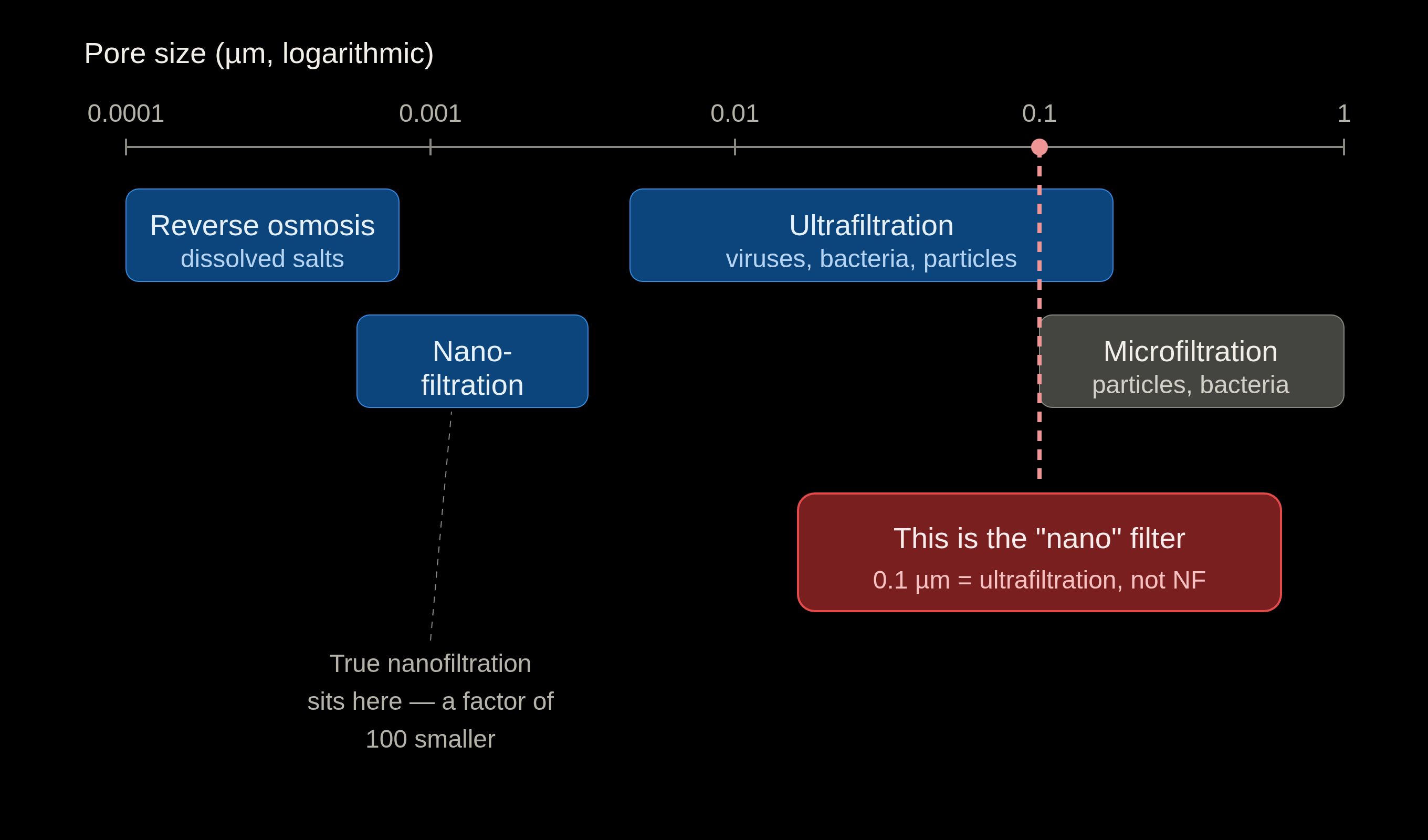
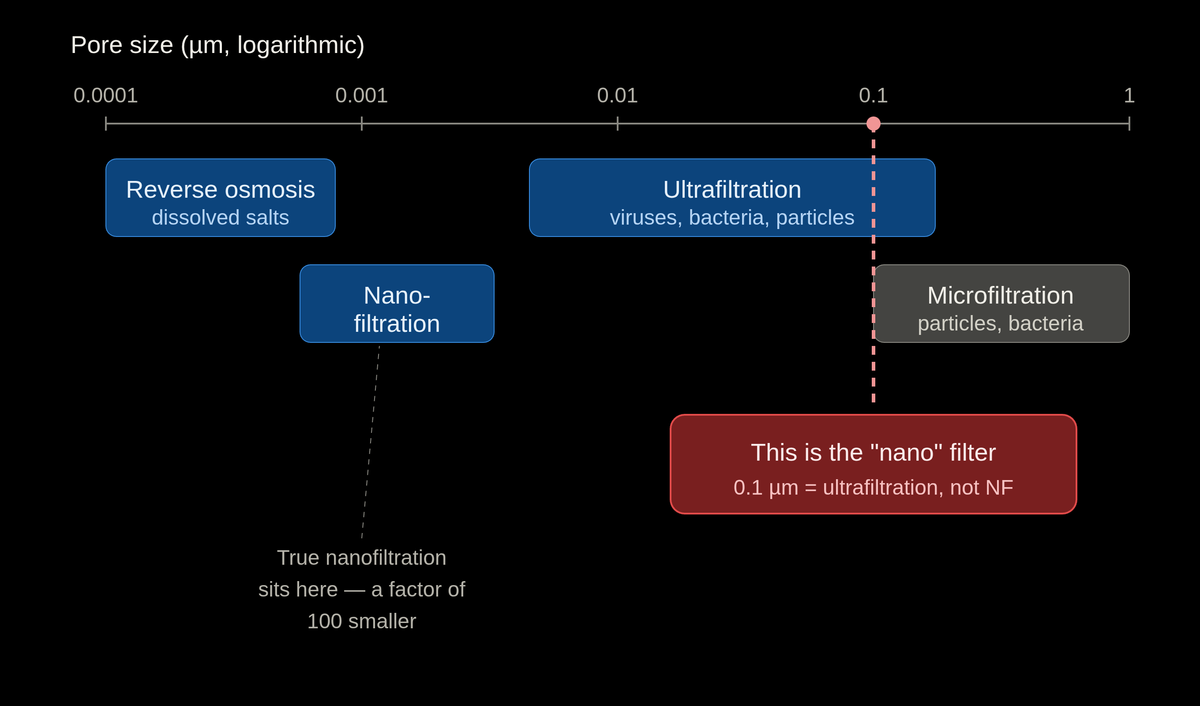
Now the label swindle becomes visible. A 0.1 µm filter sits at the boundary between micro- and ultrafiltration. Real nanofiltration begins at around 1 nanometer — roughly one hundredth of that pore size.
Between the 0.1 µm "nano filter" and genuine nanofiltration lie two orders of magnitude. A factor of 100. This is not a borderline case or a matter of interpretation. It's the difference between a compact car and a race car, justified on the grounds that both have four wheels.
Why This Matters in Practice
This is not academic hair-splitting. The difference decides what actually comes out of your tap.
A 0.1 µm ultrafiltration membrane is excellent at what it does: it reliably holds back bacteria and particles. That is real, valuable performance — especially on the road, from unknown sources, this is exactly the barrier you want. Nothing in this text denies the membrane its quality.
But the syllable "nano" raises a different expectation. Anyone reading "nano filter" intuitively thinks: this removes everything, down to the smallest dissolved substances. And that is precisely what it does not do. The following substances pass straight through a 0.1 µm membrane:
- Nitrate (e.g. from agricultural contamination of groundwater)
- PFAS — the "forever chemicals," currently the big topic in drinking water regulation
- Limescale / hardness minerals — the filter softens nothing
- Dissolved salts and many small organic molecules
These are dissolved substances. A membrane retains them only from genuine nanofiltration or reverse osmosis onward — exactly the class the name "nano" suggests, but the product does not deliver. Activated carbon works differently: it doesn't sieve substances out by size, it adsorbs them onto its surface. That makes it effective against many dissolved organic compounds — chlorine, pesticides, medication residues, and, to a limited extent, PFAS — but it does essentially nothing against dissolved ions like nitrate or hardness (limescale). No single stage removes everything; each addresses a specific group.
The customer who buys a "nano filter" out of concern about nitrate or PFAS is therefore possibly buying a technically good product for a problem this product doesn't solve at all. Not because anyone lied to them. But because a name raised an expectation that physics doesn't fulfill.
A Concrete Example from the Market
So this doesn't stay abstract: even a well-known, genuinely high-quality manufacturer like Alb Filter markets its 0.1 µm hollow-fiber module under the name "Nano." Technically, this is an ultrafiltration membrane. The filtration performance is good — that's not the point. The point is the name, which claims a filtration class the product doesn't belong to.
This is not an isolated case. "Nano" has become a marketing word across much of the industry because it sounds like progress. But an established marketing term doesn't become correct just because everyone uses it. It merely becomes a more widely shared misunderstanding.
The Three Questions That Let You See Through Any Filter
You don't need to be a process engineer to stop being led by the label. Three questions are enough:
1. What pore size in µm — and what filtration class follows from it? Don't let the unit dazzle you. When in doubt, convert to µm and classify: 0.1 µm is ultrafiltration, no matter what the product is called. Real nanofiltration lies at ~0.001 µm.
2. Which substances are specifically retained — and are the conditions stated?
Take "reduces up to 99.9%." On its own, that's a number without meaning — it doesn't say what, by how much, or under what conditions (feed concentration, flow rate, service life). Serious performance is expressed as a log reduction value, and the rule is simple: the higher the log number, the better. Each step means ten times fewer organisms get through — so log 6 is a thousand times stronger than log 3. You should be able to find this on any professional filter, without having to search for it for ages.
3. Does the class match my problem? Concerned about germs from an unsafe source? Then UF (0.1 µm) is exactly right. Concerned about nitrate, PFAS, or limescale? Then you need NF with AC or RO — a UF "nano filter" won't help you, no matter how advanced its name sounds.
What This Is Really About
You can sell a filter by giving it a name that promises more than it delivers. Or you can explain to people how water filters really work — and trust them to make the right decision themselves.
We think the second option is the better one. Not because it sells better — but because a customer who understands what they're buying is the only customer who stays satisfied in the long run. A filter is not magic. It's physics you can calculate. And anything you can calculate should also be written on the label — in the right unit, with the right class, without an impressive syllable in front.
That's the standard we apply to our own products. And it's the standard you should apply to every filter — ours included.
When in doubt, ask for the pore size in µm and the filtration class. Anyone who can't give you a clear answer is selling you a name. Anyone who gives it to you is selling you a filter.