
Front Runner Rack Corrosion - A Closer Look at the Real Cause - Part 1
Two years, two Central European winters, no off-road abuse worth mentioning — and the coating on my Front Runner rack is blistering off in patches. The aluminium profiles show white powdery deposits under the paint and the steel brackets are rusting.
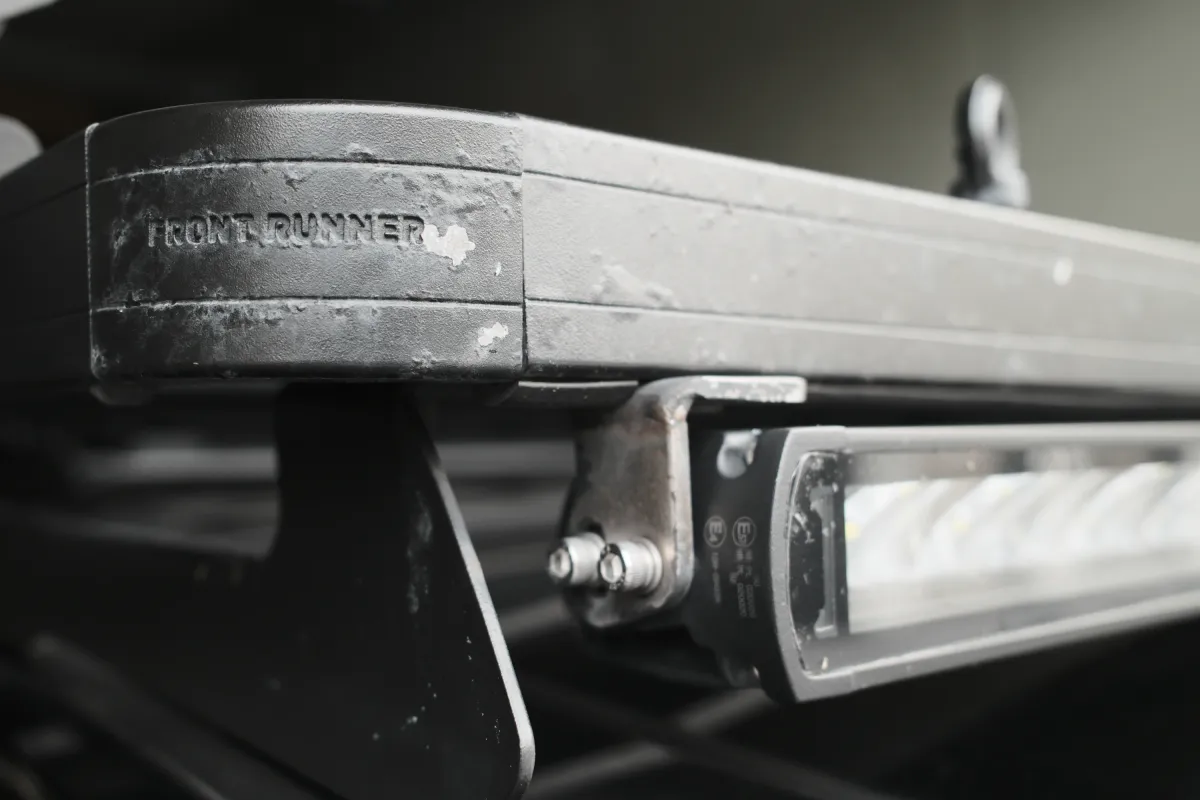
I bought this Slimline II rack from Front Runner in February 2024. Back then, everything just looked the way it was supposed to. Two and a half years later, it doesn't.
As I write this, the rack is just two and a half years old. We live in central Europe, where winters are long and the roads see a lot of salt. Our 2009 Land Cruiser J120 pushes through those cold, icy months like any other vehicle here — and it has done so for far more winters than the rack has.
Which raises the question: why does this aluminium rack look like it's corroding from within after only two seasons, when the Land Cruiser has endured many more salty winters and is still in better shape?
The question is:
What went wrong and what can be improved?
This is the first part of a series on materials, manufacturing quality, and how to check both on the gear you already own.
Materials & Coatings
Aluminium
In automotive manufacturing, aluminum is frequently used for lightweight construction and body components. Engine blocks are also primarily cast from aluminum. This saves a significant amount of weight and thus reduces fuel consumption. In addition, aluminum forms a natural oxide layer that is self-healing and protects the material from corrosion. This layer is very thin and therefore not visible. There are coating processes for aluminum that increase its weather resistance. However, I would like to focus here on just the two most important ones:
Anodising
An electrochemical process that reinforces aluminium's natural oxide layer through anodic oxidation. The component is degreased in an alkaline bath and pickled beforehand, so that the electrolyte wets the substrate evenly and the oxide layer grows to a uniform thickness. After anodising, the layer must be sealed — usually in boiling water or nickel acetate — to close its pores. Without sealing, corrosion resistance remains poor.
The decisive difference to any applied coating: an anodic layer is not deposited onto the aluminium, it grows out of it. The oxide is chemically continuous with the substrate, so there is no interface at which adhesion can fail. An anodised surface can be worn through mechanically, but it cannot blister or delaminate.
Powder coating
Aluminium parts for vehicle accessories such as roof racks are usually powder coated. Powder coating is a surface finishing process in which a fine, dry powder is applied electrostatically to an electrically conductive workpiece. The coated part is then heated in an oven, where the powder melts, cross-links and cures into a hard, closed film. The process falls into three phases: preparation, application and curing.
Surface preparation is just as demanding here as it is for anodising:
- Degreasing — removal of oils, forming lubricants and handling residues.
- Pickling — removal of the natural oxide layer and the deformed surface skin left by rolling or extrusion. Qualicoat specifies a minimum removal of approximately 1 g/m². Alkaline pickling leaves a smut of alloying constituents behind, which has to be removed by an acidic deoxidising step.
- Conversion coating — aluminium re-oxidises within seconds, and that fresh oxide layer is not a suitable substrate for the powder. A chemical conversion layer — chromate conversion to DIN 50939, or a chromium-free titanium/zirconium process — creates a thin adhesion-promoting film that also improves corrosion resistance. Modern lines increasingly use chromium-free processes to reduce environmental impact.
- Drying — the part must be dried thoroughly before the powder is applied. Residual moisture from the rinsing baths would evaporate during curing and damage the film.
The organic layer formed by powder coating is inherently permeable. Water and oxygen diffuse through it within hours and reach the metal underneath, regardless of film thickness.
Protection therefore does not rest on the coating acting as a barrier — it rests on the bond between the conversion layer and the organic film holding up even when that interface is saturated with water. Where the pretreatment is inadequate, this is precisely where the system fails.
What happened to my rack?
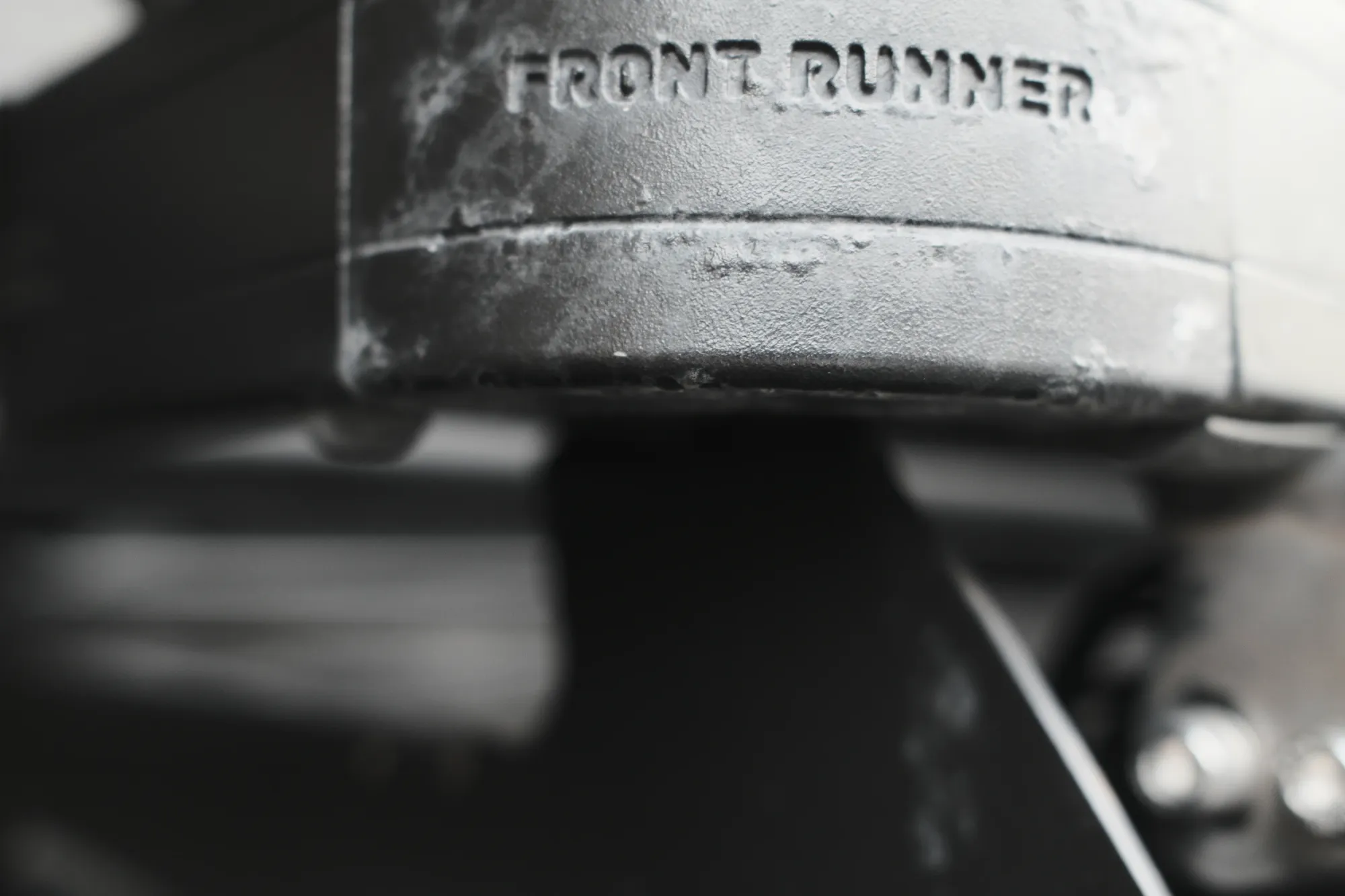
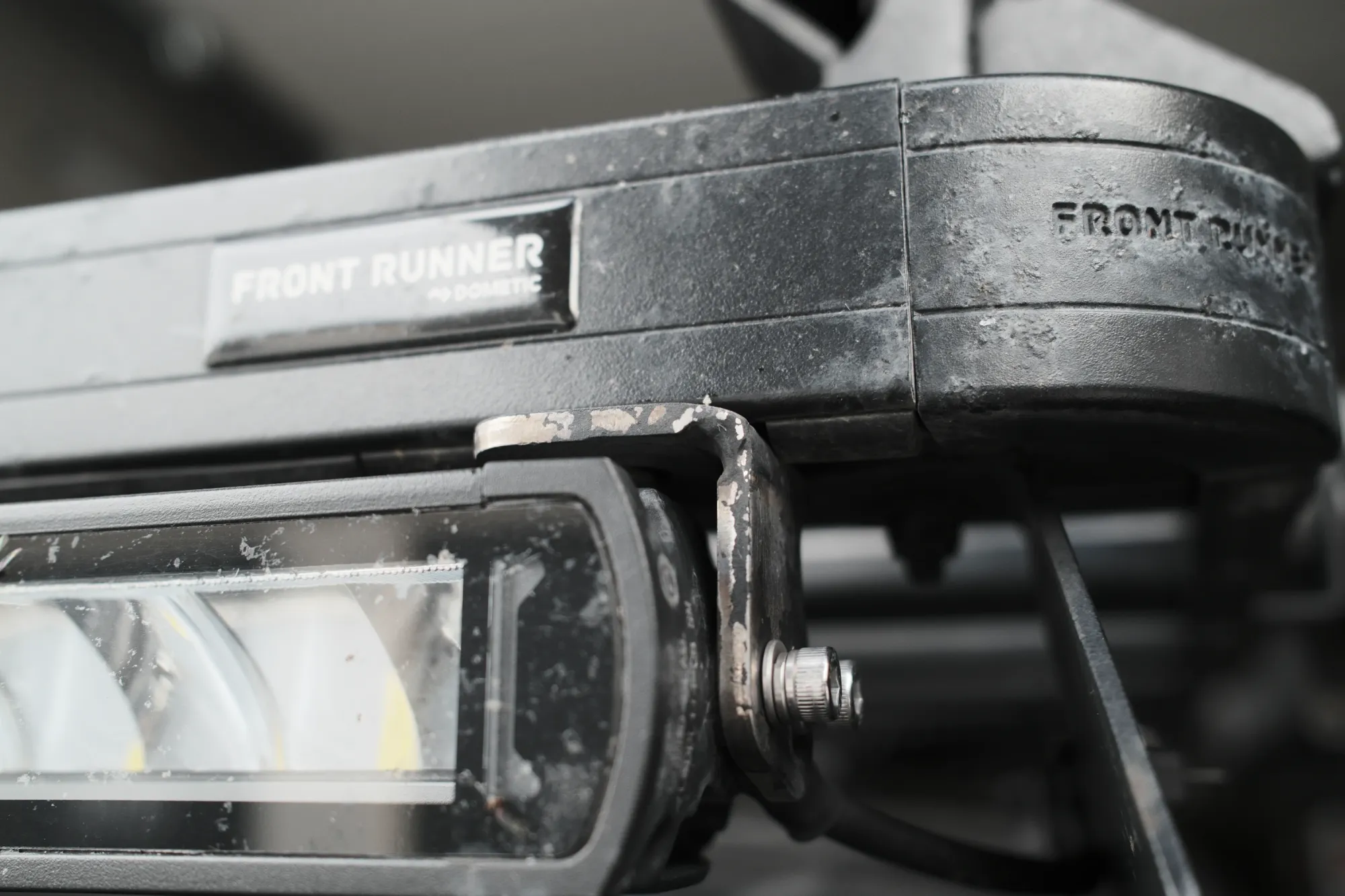
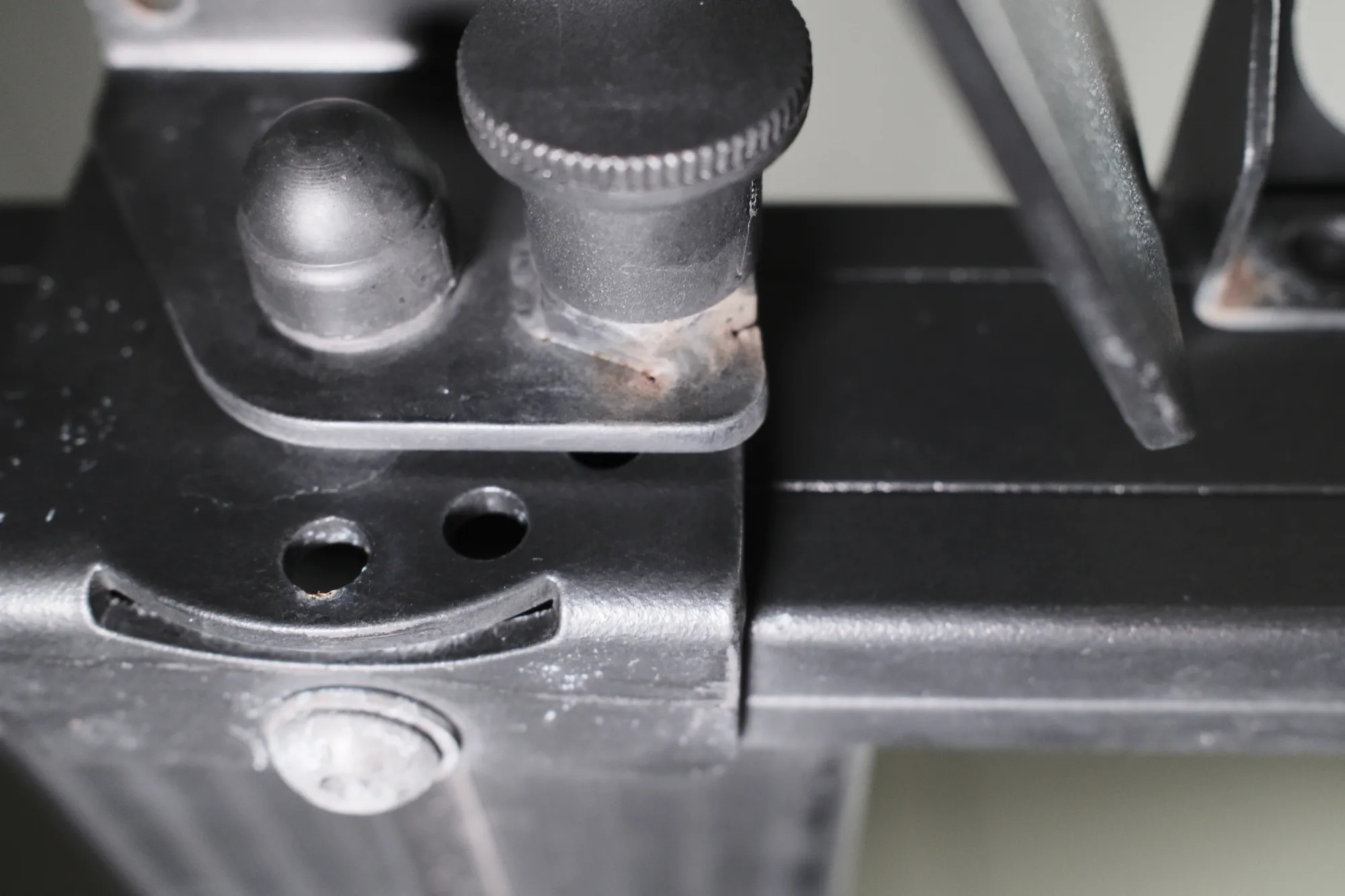
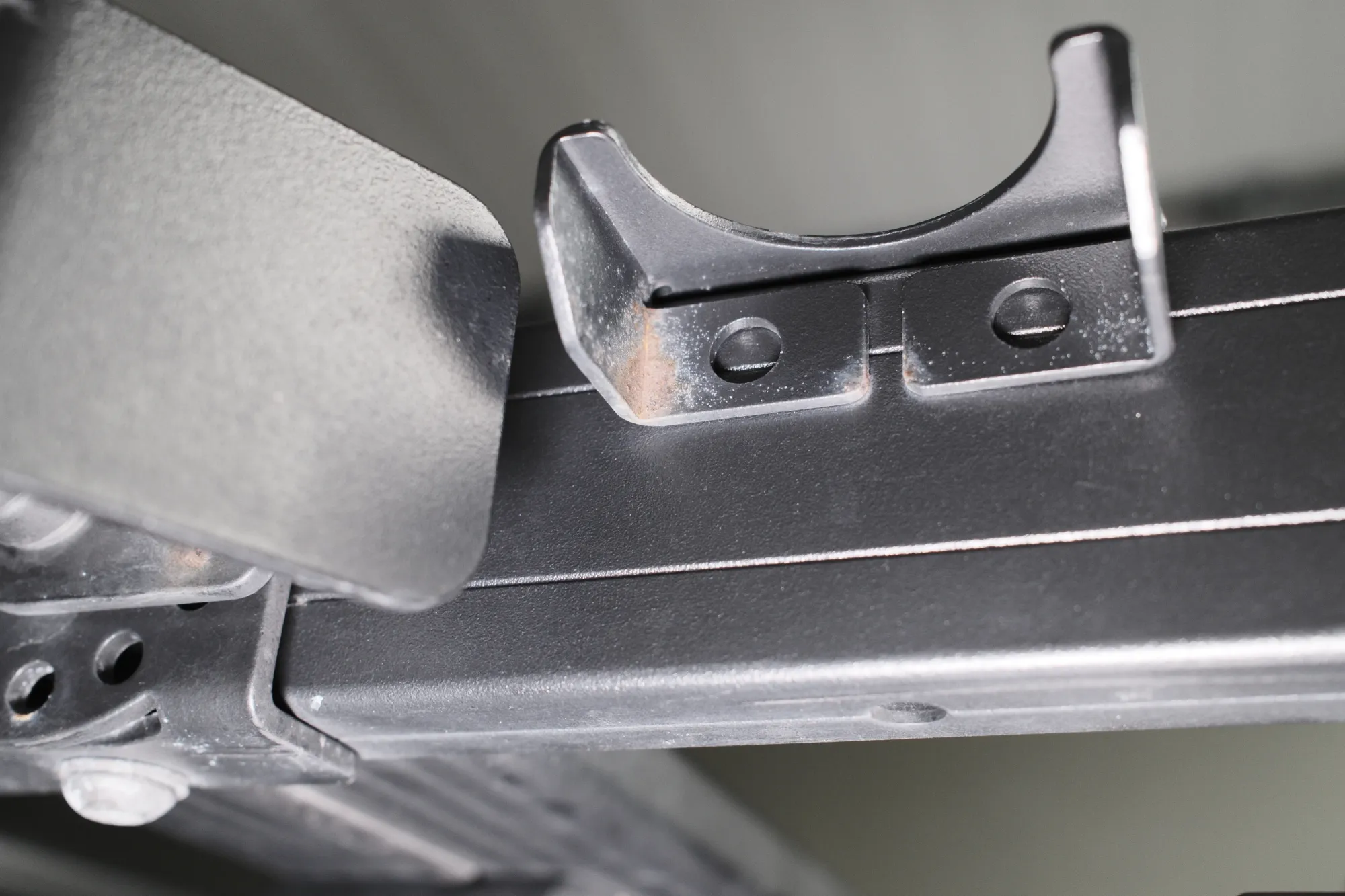
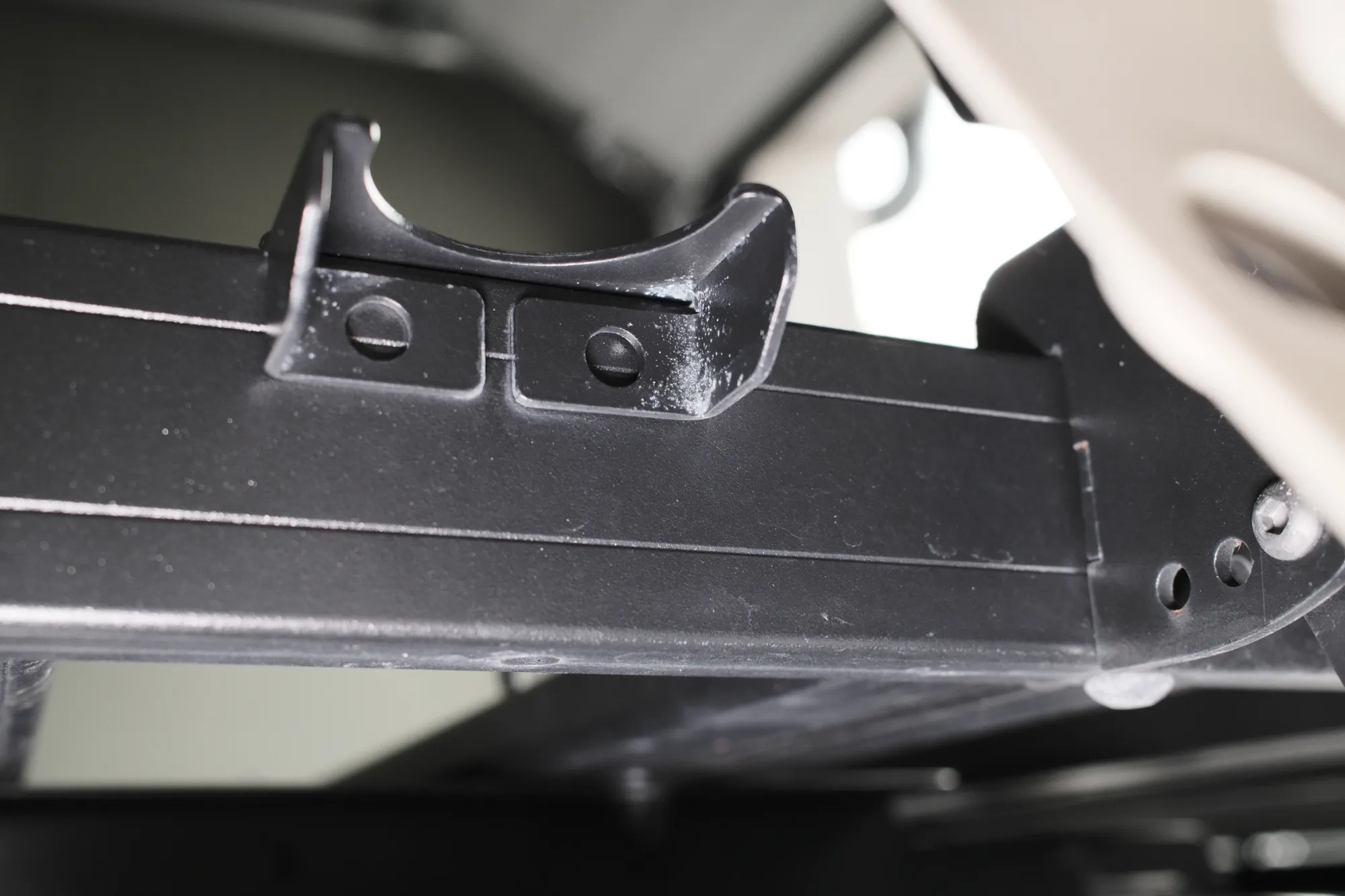
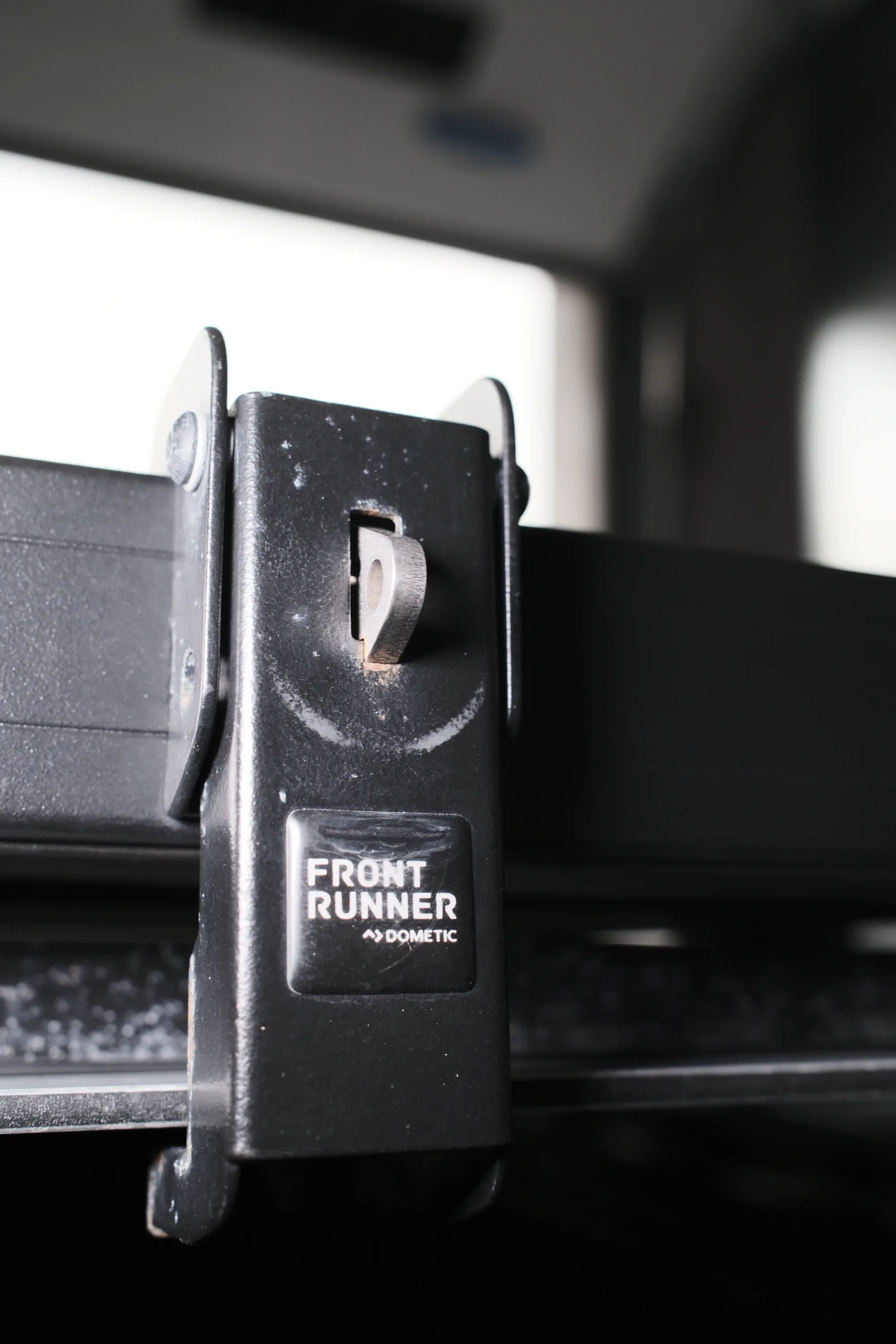
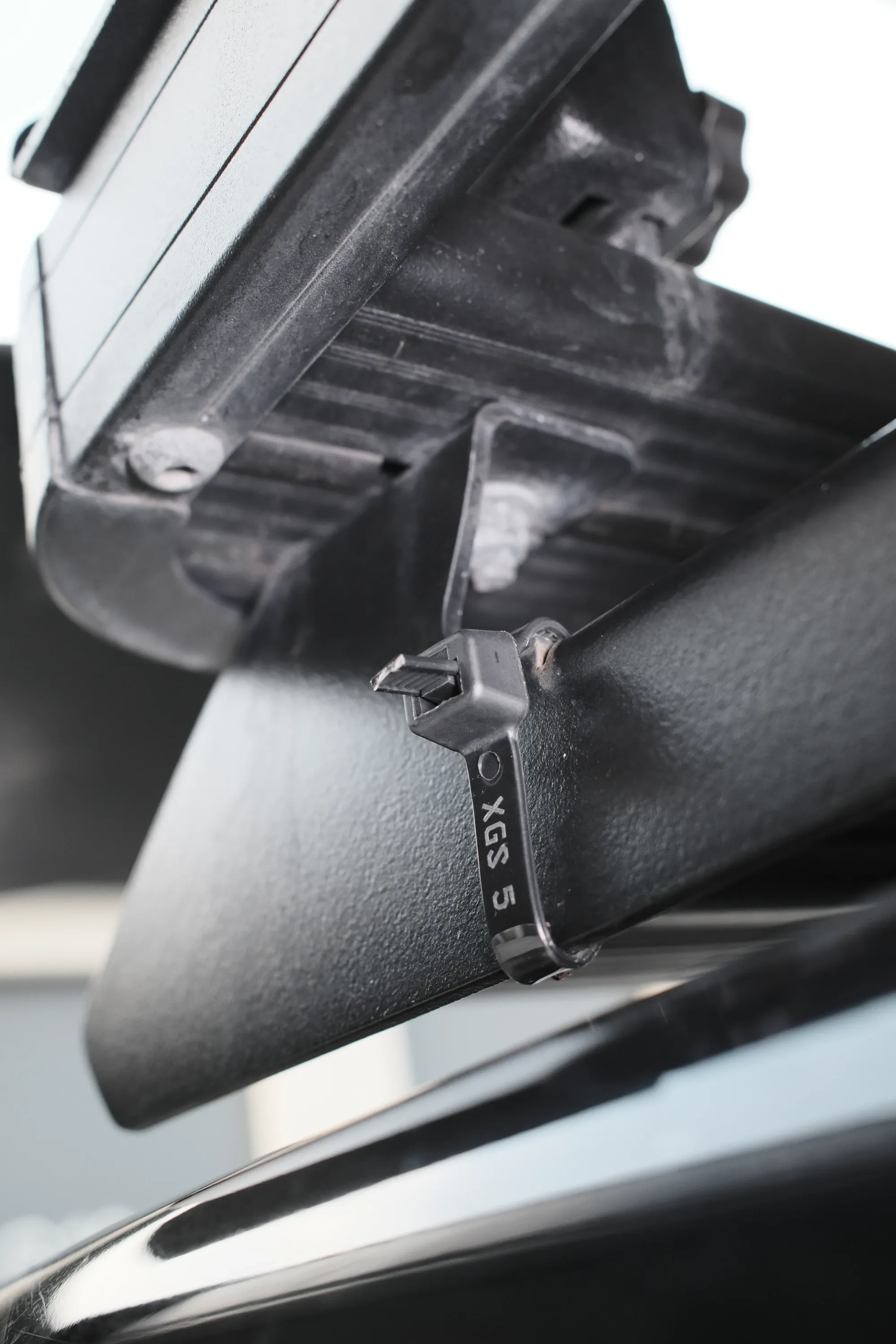
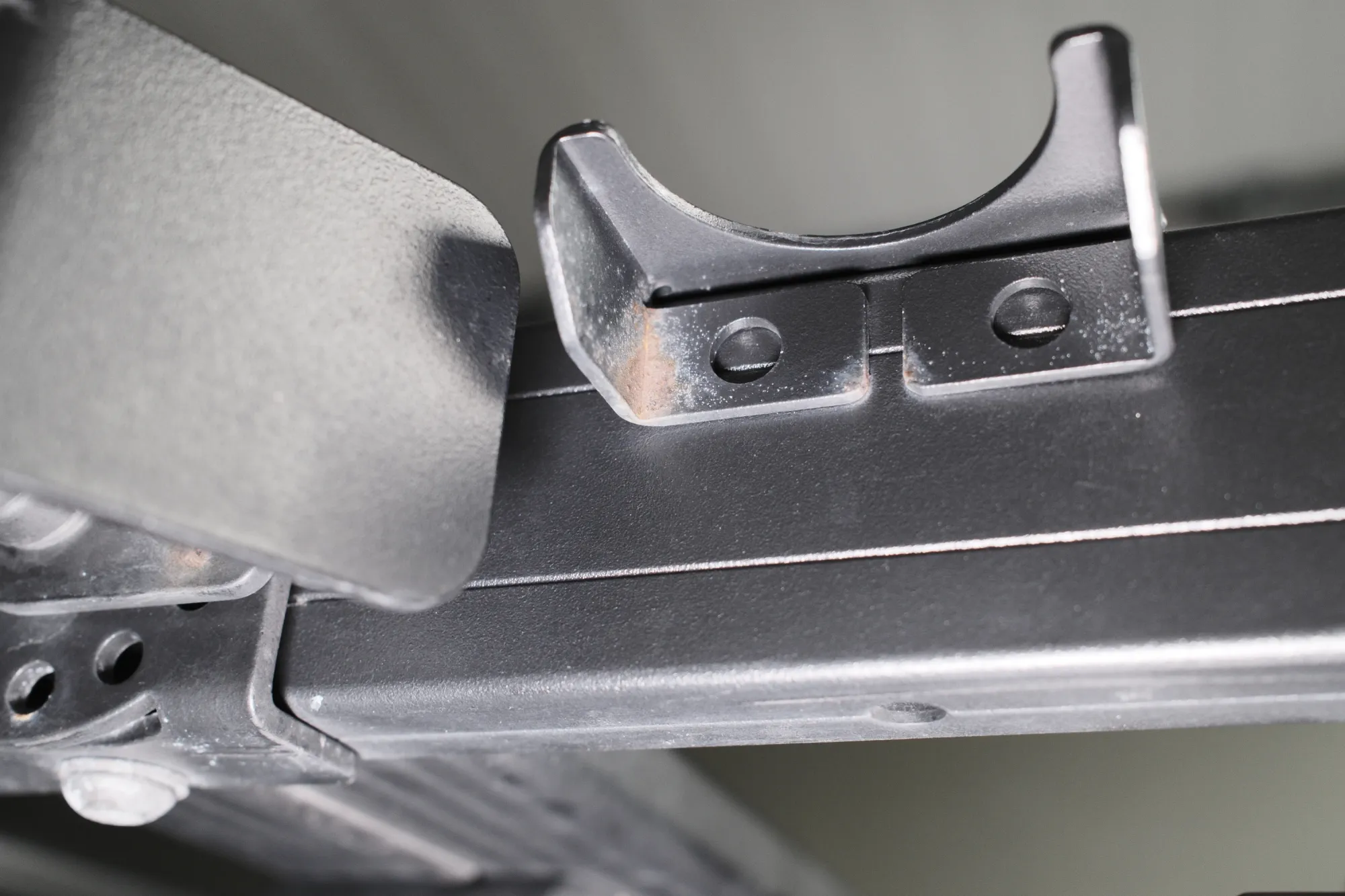
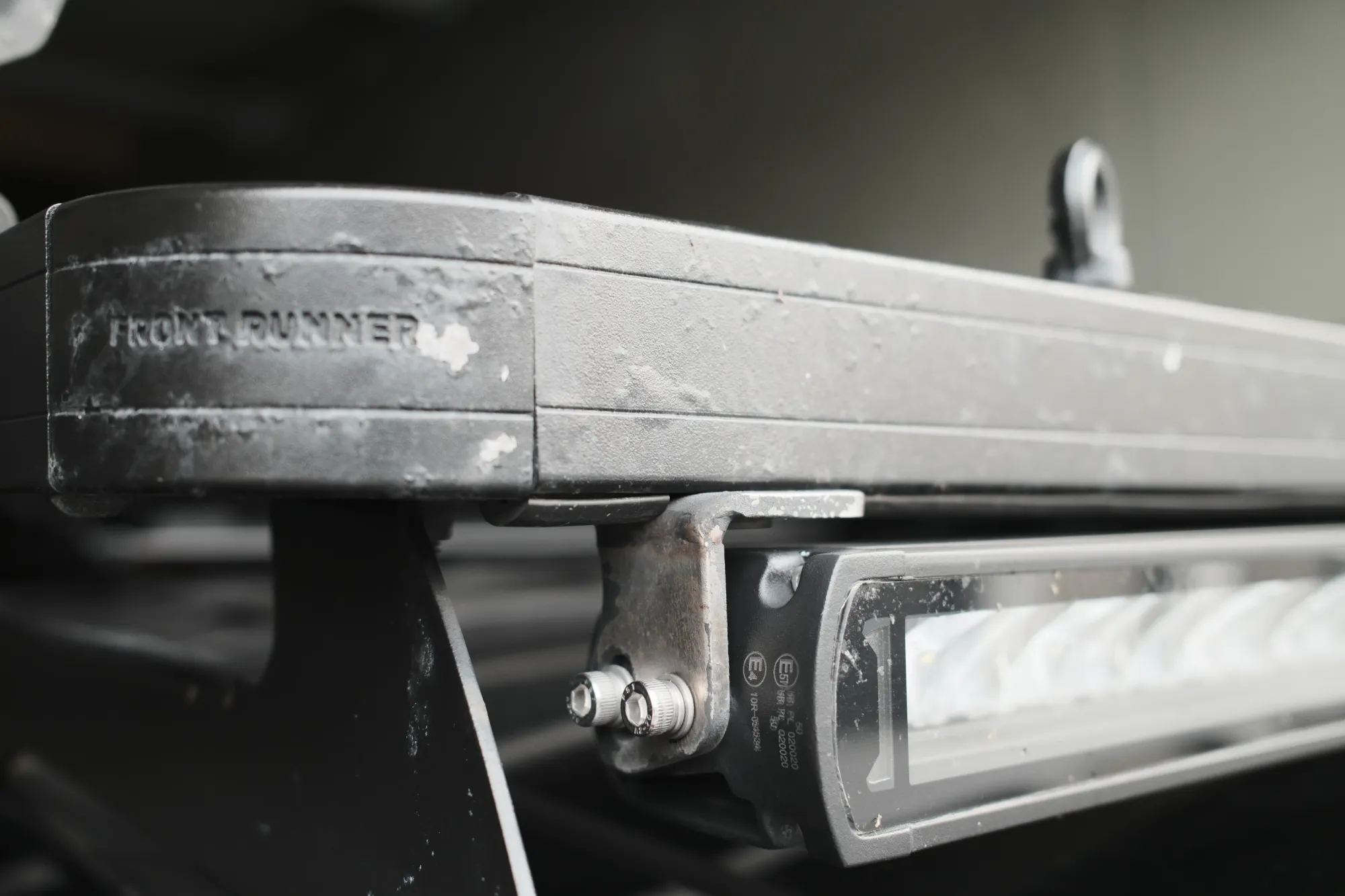
The photographs below show the current condition. The rack is aluminium, powder coated in black; the mounting brackets bolted to it are steel. On the aluminium sections, the coating has blistered and flaked away, leaving a white, powdery deposit behind. On the steel brackets, the coating has come off around the welds, and the exposed metal has gone rusty. Almost no part of the rack is unaffected.
None of this is impact damage. There are no stone chips, no scratches, nothing I could point to and say the coating was broken here first. The damage appears in the middle of otherwise undisturbed surfaces — which is what makes it interesting, and what the rest of this article is about.
Three metals, all fail
The rack combines all three: aluminium for the extruded profiles and the formed front panel, zinc-plated steel for most of the brackets, stainless steel for the light bar mount. All three are corroding, and it is tempting to read that as a materials problem. It isn't. Each of these metals is capable of surviving decades of European road salt.
Aluminium protects itself with a natural oxide film, only a few nanometres thick, that reforms within seconds of being damaged. That film is also the reason powder does not adhere well to bare aluminium. Pickling removes it, and a conversion coating replaces it with a layer that both bonds to the metal and bonds to the powder. Skip the pickling, and the coating sits on the extrusion skin and forming lubricant residues instead. It will hold for a year or two in the dry, then blister as soon as moisture reaches the interface.
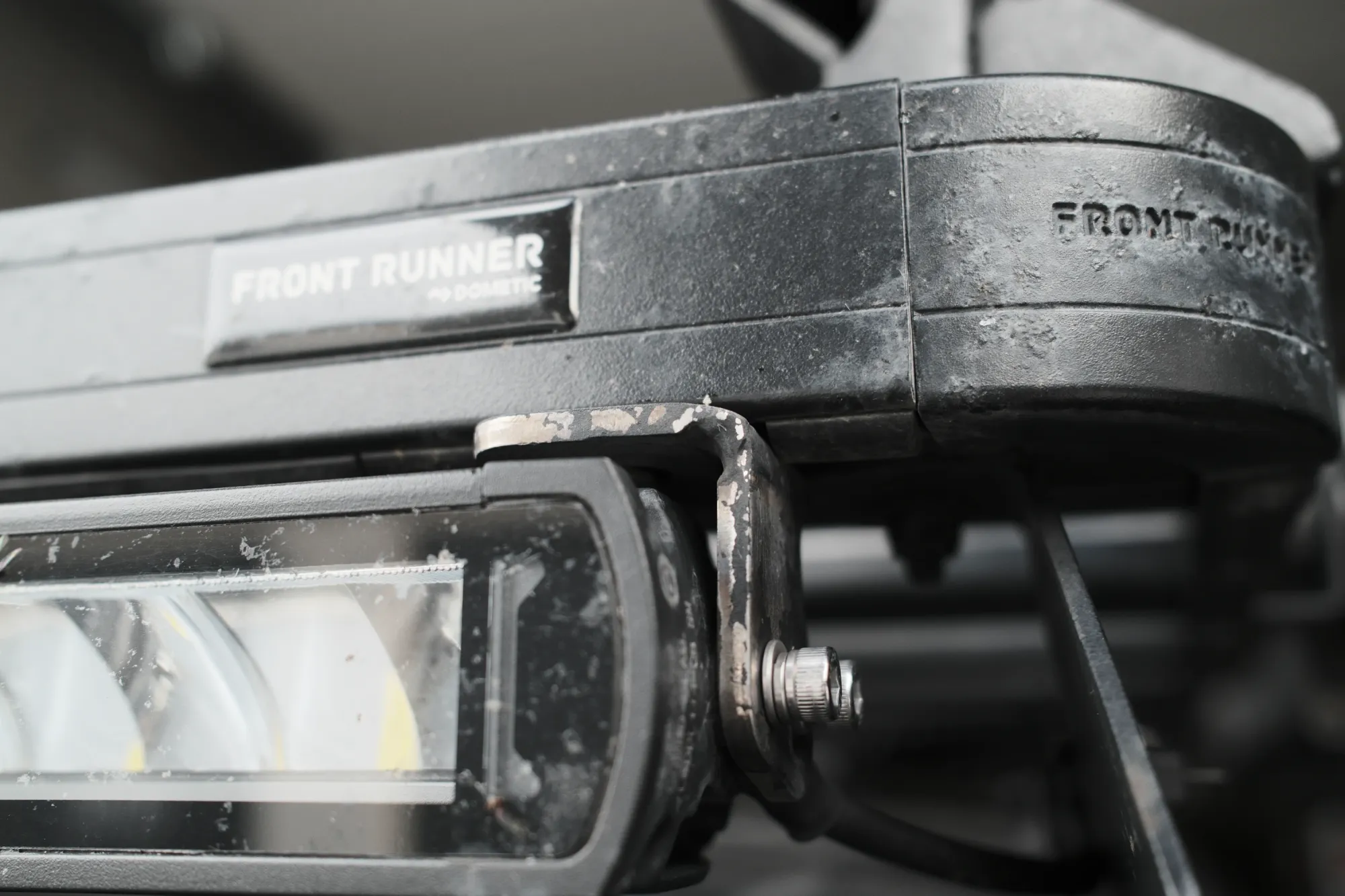
Zinc-plated steel has no self-healing oxide. Iron oxide is porous and does not passivate, which is why steel needs an applied protective layer rather than an intrinsic one. Zinc provides it — sacrificially, corroding in place of the steel underneath, which is why a scratch in galvanised sheet does not rust the way a scratch in painted steel does.
The brackets on this rack are folded sheet, not welded. That shifts the weak points but does not remove them. Electroplated zinc is typically only 5 to 12 µm thick and has to follow every bend; on the outside of a tight radius it is stretched beyond what it tolerates and cracks. Cut and punched edges are bare steel to begin with — the surrounding zinc protects them galvanically, but only across a limited distance. Both are fixable: plate after forming rather than form after plating, or seal the edges afterwards. Neither appears to have happened here, and the rust on these brackets sits exactly where you would predict: along the folded edges and the cut borders, not in the middle of the flat faces.
Stainless steel relies on a chromium oxide passive layer, which requires at least 10.5 % chromium in solid solution to form. Welding compromises exactly that: heat-tinted oxides in the heat-affected zone are chromium-depleted, and in unstabilised grades chromium carbides precipitate at the grain boundaries. Pickling and passivating after welding removes the damaged zone and lets the passive layer rebuild. Without it, the weld area corrodes while the surrounding material stays clean.
Aluminium Corrosion Patterns
Filiform corrosion
A specific form of corrosion that appears as thin, worm-like threads spreading underneath a coating. It requires a defect to start from — a scratch, a cut edge, a drilled hole, anywhere the coating does not fully cover the metal.
What drives it is a difference in oxygen concentration along the thread. At the leading head, oxygen has been consumed and the metal dissolves anodically. Behind it, where oxygen still reaches the metal, the cathodic reaction takes place. The head keeps advancing, and the corrosion product left behind occupies two to three times the volume of the metal it came from — enough to lift the coating from the surface. Once lifted, moisture and chlorides travel further along the exposed interface, and the process feeds itself.
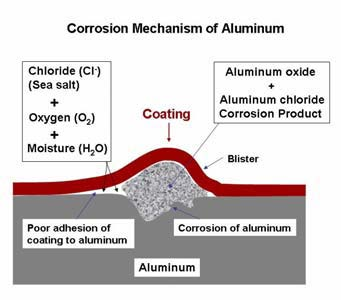
It is worth separating this from what happens when the pretreatment was inadequate. Filiform corrosion is directional: it starts somewhere identifiable and travels. Adhesion failure is not — it appears as scattered blisters in the middle of undamaged surfaces, wherever contamination happened to sit at the interface. Both end up lifting the coating; the pattern tells you which one you are looking at.
Galvanic corrosion
When two different metals are electrically connected and both sit in an electrolyte, their difference in electrode potential drives a current. The less noble metal becomes the anode and dissolves; the more noble one becomes the cathode and is protected. Electrons travel through the metallic contact, ions through the electrolyte — both paths are needed to complete the circuit.
The area ratio matters more than most people expect. A small anode connected to a large cathode concentrates the entire corrosion current onto a small area, and it perforates fast. Reverse the ratio and the same pair of metals may last for years. This is why a steel bolt in an aluminium profile is a far worse combination than an aluminium panel held by a stainless bolt — the same two metals, opposite outcomes.
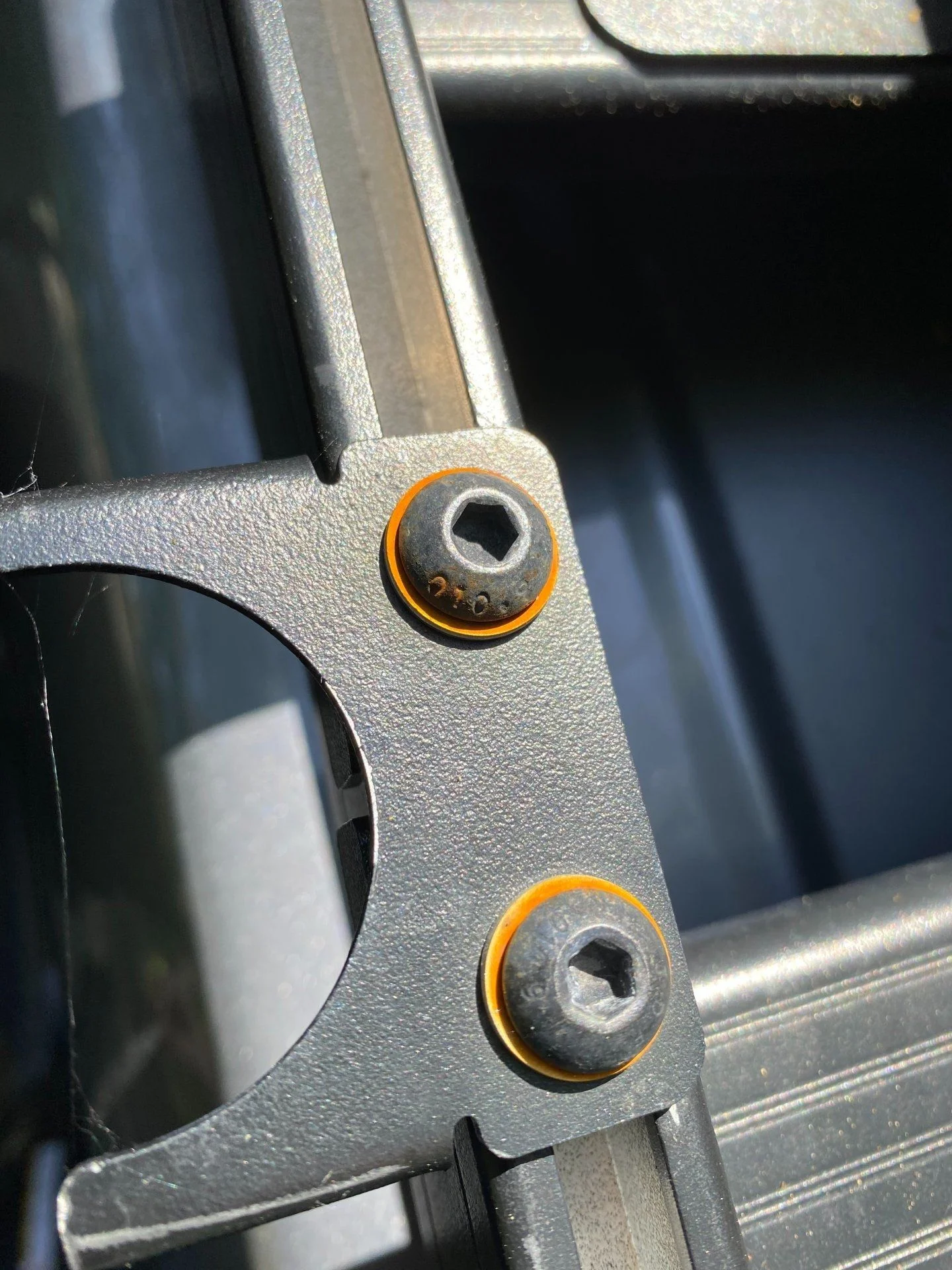
A user on the ih8mud forum described corrosion on his Front Runner rack back in 2021. In his case the rust appeared on the washers rather than on the rack itself, with part of the hardware only a few months old at the time. A single forum post is an anecdote, not evidence — but it is the area-ratio effect in its textbook form: small steel parts bolted to a large aluminium structure.
So which one is it?
Everything so far has been observation and mechanism. What I have not done is answer the question the photographs raise: is this normal wear on a rack that has seen two Central European winters, or is it a coating that was never going to last?
The damage pattern points one way. There are no impact marks, and the blisters sit in the middle of undisturbed surfaces rather than spreading from an edge — that is adhesion failure, not filiform corrosion. But a damage pattern is an argument, not a measurement. Anyone can look at the same photographs and call it road salt and bad luck.
The useful thing about coatings is that the argument can be settled. There are standardised tests for exactly this, and the surprising part is how little equipment they need. Two hours in boiling water, a craft knife, a roll of tape — that is the core of a test that the industry uses to detect precisely this failure mode, and the pass criterion leaves no room for interpretation. Either the coating survives it or it doesn't.
In the next part I run that test on my own rack, with the standards it comes from, what the result means, and how to do it yourself on any powder-coated part you own. If your rack, your awning brackets or your drawer system have started blistering somewhere, that article will let you find out whether you are looking at the same thing I am.
Stay tuned & subscribe for more to come!