
Introducing the WeissExplorers Trip Planner
Four kids, one Land Cruiser, and 4,500 km through three countries. Good planning isn't optional — it's what makes the difference between a stressful trip and a great one. Here's why I built my own overlanding trip planner.

Two small kids and two big kids. No parents around. We're the grown-ups — and we both have day jobs to go along with it. On top of that, I'm building my own business. More work, yes — but honestly, it's fun!
So is cruising through Europe in our 2009 Toyota Land Cruiser J120, exploring new countries and meeting people along the way. We love our Land Cruiser — it's a reliable companion we can simply count on. It brings family life and adventure together under one roof — and that's not as easy as it sounds.
Our tipi tent is our mobile home. Camping, for us, means being out in nature. It doesn't mean sleeping locked up in sealed plastic boxes — and honestly, I'm not sure that's what camping is supposed to feel like. Especially in summer, I love the fresh breeze drifting through the tent at night — it feels like sleeping under open skies. It also means waking up at 3am because something small and crawly decided to walk across your face. 😄 Both of these things are freedom to us — a tipi tent on a meadow in the middle of nowhere, in tune with nature.
On our last trip through Spain, we booked five private pitches across three countries — some of them months in advance, because they would have been gone otherwise. Even when demand is lower, we book early. Just to have a solid framework in place.
Things can always go sideways, of course. In early June we had to cut a trip in Slovenia short because of severe thunderstorms. It happens. But without a plan, you don't even have a baseline to deviate from.
That's where a digital planning tool comes in — something to help us think through and structure our overlanding trips properly. That's exactly why we built the Overlanding Planner: a tool that reflects the reality of travelling with kids, fixed pitches, and limited holiday time — without killing the spontaneity.
The first version was born for our Spain Trip 2025: a printed calendar. On it: our stops, booking durations, and — most importantly — drive times between each location.
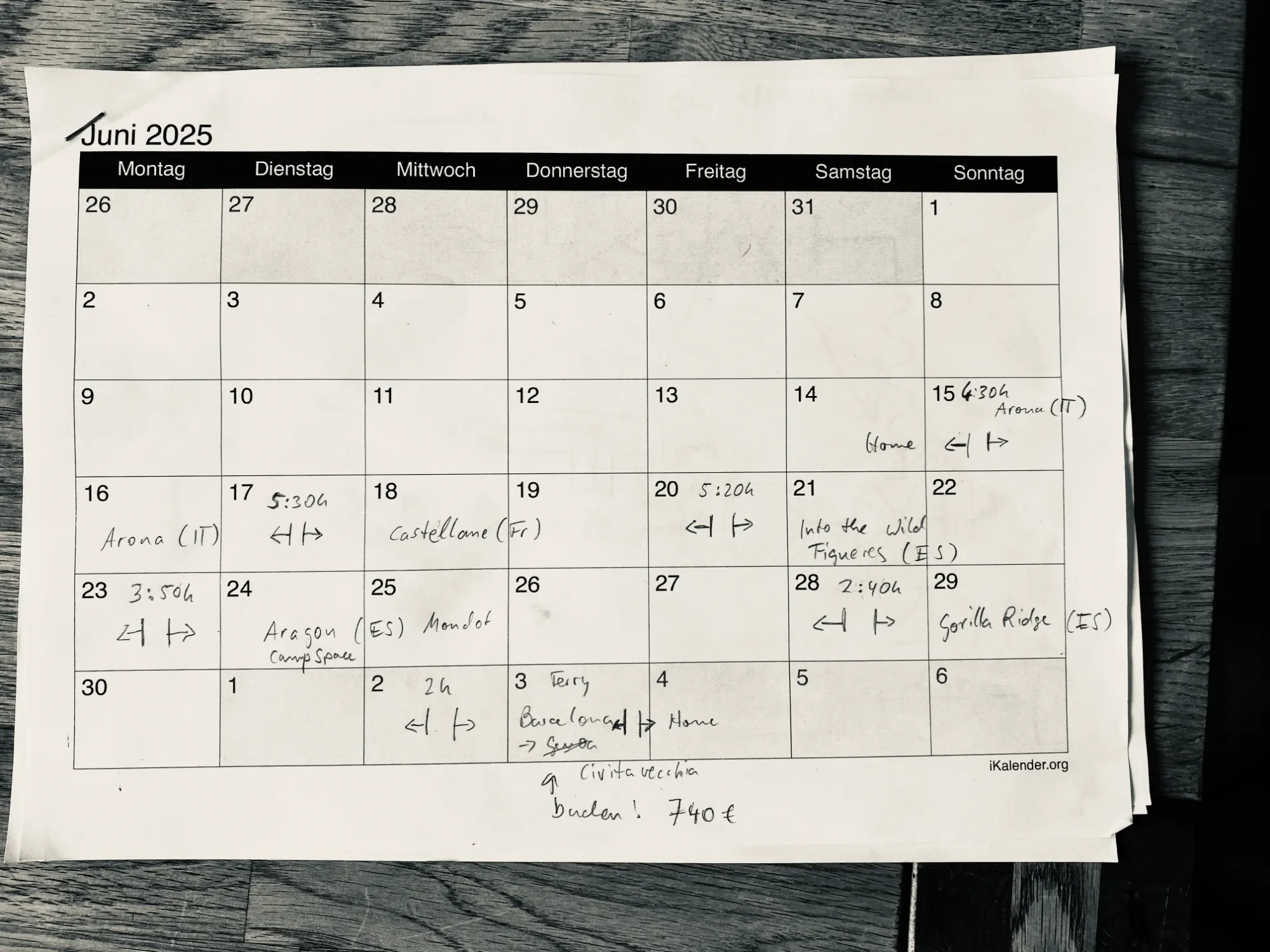
Paper — fair enough. But when it comes to efficient planning, a digital app has some real advantages. It lets you test multiple route variations and tweak them on the fly. And at the end of it all, you can still print everything out. Win-win.
Making the most of our holiday days was important to us. After all, our Spain Trip 2025 covered more than 4,500 km across 2½ weeks. To keep that from becoming stressful for us and the kids, I planned everything carefully — but always left enough room for spontaneous day trips. The only part that was ever tiring was arriving and leaving, because of setting up and breaking down camp. But that was purely physical — everything had its fixed spot in, on, or on top of the car.
My goal was simple: plan a longer trip through Europe with less stress and more certainty. Especially when travelling with kids, we're tied to a schedule — booked pitches, enough breaks, and reasonable drive times. We love the freedom of travelling in our own vehicle, at our own pace. But that freedom still needs a framework.
For navigation and route exploration I use a mix of apps — OsmAnd, Garmin Explore, and Wikiloc. OSM-based maps in particular are often far more detailed than Google or Apple Maps, especially off the beaten track. That said, POI locations are still frequently wrong or placed in completely the wrong spot. So the rule is: always check the signs before turning onto an unknown road or track — never trust the nav blindly. Our old VW Touran once confidently led us down a dirt track with no idea whether we'd make it through, find a turning point, or whether the track would get better, worse — or just stop. The Land Cruiser handles that rather differently. 😄
None of the apps I use are built for trip planning in the way I needed. So I built my own.
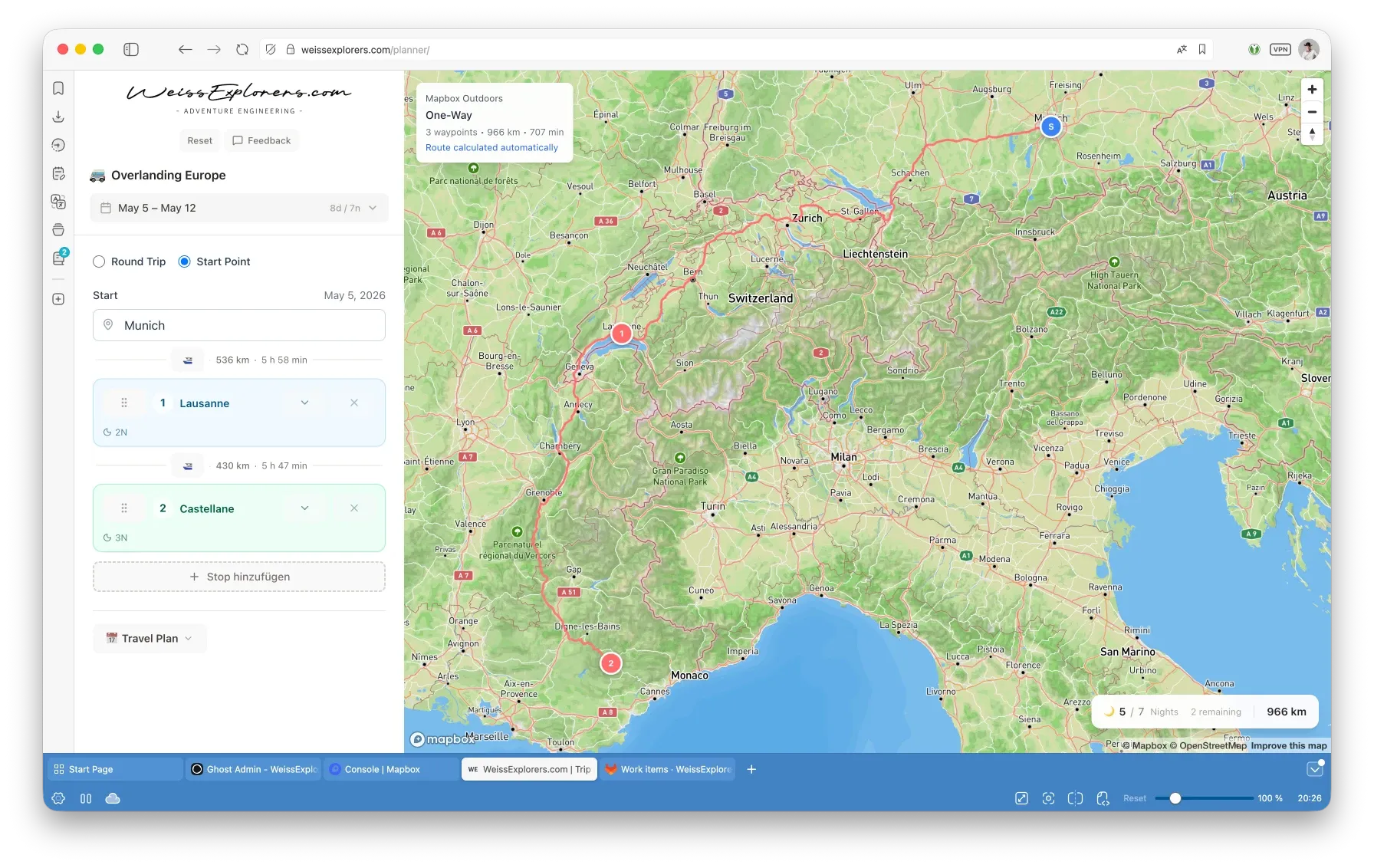
The WeissExplorers Trip Planner is lean and does exactly what we need — nothing more, nothing less. A clean map view, a sidebar with stops, distances and drive times, and the option to switch between driving and ferry. You can adjust your travel dates, reorder stops, and add overnight stays for ferry crossings. That's it.
Research
Roadtrippers is the best-known app for multi-day trips — up to 150 stops, drag & drop, and a huge database of points of interest. The catch: from 2026, you'll need a Premium subscription for more than 7 waypoints, which is almost always necessary for multi-day tours. The bigger issue for European overlanders, though, is the clear US focus — European campsites, ferries, or mountain passes simply aren't on the radar. Users also report that switching to navigation mode wipes the entire trip plan.
Wanderlog is free, cleaner, and popular with frequent travellers. Unlimited stops, route optimisation, and drive times between stops sound promising — but the app is clearly built for city breaks: hotels, restaurants, flights. For an overlander with a rooftop tent, a ferry booking, and a campsite check-in, it's the wrong tool. Too busy, too generic, too focused on city trips and budget travel.
Furkot is a tool for planning nerds. Detailed day structure, lots of parameters to configure — but the interface is anything but intuitive and the UI looks like it's from 2012. Anyone planning their first trip will quickly get lost in the sheer number of options.
The bottom line: none of these tools address European overlanding with a vehicle and a family. Ferries as a dedicated transfer type, overnight stays on the crossing, fixed time windows for school-age kids — that's a gap the Trip Planner at WeissExplorers.com fills.
The app was built around the needs of a specific group of travellers — not the other way around.
... & then the Develpoment
After many longer trips, I know what I need for effective trip planning — and what I don't. That's what shaped the app. I knew what mattered and which features were worth building.
Ferry crossings were one of them. On our way back from Spain, we took the overnight ferry from Barcelona to Civitavecchia, Italy. The kilometres didn't really matter here — what mattered were the overnight stays on board and the departure and arrival times. We could have taken the ferry to Genoa instead, but that one leaves Barcelona early in the morning. With kids, a drive to the port, and everything to pack up — that's almost impossible. So we chose the evening departure and spent the day in Barcelona without any stress.

Not every overlander travels the same way. Some just hit the road and see where it takes them. We don't. Defined stops give us the framework for our route. Between each stop, the app shows distances and drive times — so you can decide whether there's room for a detour or a longer break along the way. That's exactly what we did on the leg from Aínsa to Benifallet. We had enough time for a side trip to the Bardenas Reales — highly recommended. Read more about that here.
Summary
Planning a longer overlanding trip is no small task — especially with kids and a fully loaded vehicle. Good planning helps keep a clear head, so you can focus on what actually matters. And with a Plan B route in your back pocket, you can sit back and enjoy the journey with a lot less tension.
Building the app was fun. We use it actively for our own trip planning. I've learned a lot along the way and can now feed new overlanding experiences directly into further development. I'm also genuinely looking forward to your feedback!
Planning a trip with the WeissExplorers Trip Planner App
So What's Next?
An import and export function is on the list, so you can save your own routes. A user portal could cover these features as well — but that requires a proper backend database connection. To ensure data privacy, there are a few important points to address during development and operation.
The app is live — give it a proper test and let me know what you think. There's a feedback form directly inside the app.